

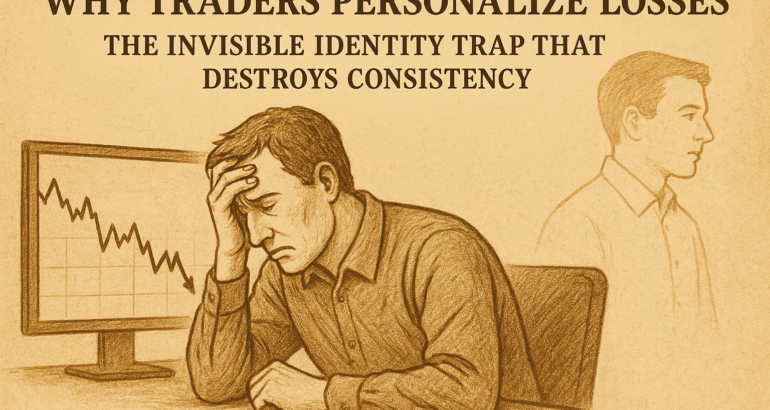
Every trader remembers the first time a loss stopped feeling like a number and started feeling like a judgment. The trade went wrong, but what lingered afterward was not the loss itself — it was the meaning attached to it. A quiet inner dialogue began forming questions that had nothing to do with charts or strategy.
“What’s wrong with me?”
“Why do I keep doing this?”
“Maybe I’m not cut out for trading.”
This is the moment where trading stops being a financial activity and becomes an identity conflict. And once that line is crossed, consistency becomes almost impossible.
Most traders believe losses hurt because of money. That’s only partially true. Losses hurt because the human brain interprets them as personal failure, even in environments where outcomes are probabilistic and impersonal.
This blog is about that hidden mechanism — why traders personalize losses, how it quietly alters behavior, and why most traders never recover consistency once losses start attacking identity instead of capital.
The Brain Is Wired to Protect Identity, Not Capital
The human brain evolved to survive in social environments. In those environments, mistakes had meaning. Failure affected status, trust, and survival. As a result, the brain developed powerful systems to protect identity and self-worth.
Trading triggers those same systems — but in a completely inappropriate context.
A losing trade activates the brain’s threat response, not because money is lost, but because the loss is interpreted as information about you. The brain does not naturally distinguish between:
- “This trade lost”
and - “I failed”
In probabilistic systems, this distinction is essential. But biologically, it does not exist by default.
Professional traders learn to build that separation consciously. Retail traders experience losses as personal verdicts.
Why Losses Feel Like Rejection, Not Information
In most areas of life, repeated failure signals incompetence. If you fail an exam repeatedly, something is wrong. If a business fails repeatedly, adjustments are needed. The brain is trained to treat repetition as feedback.
Markets break this logic.
You can execute perfectly and still lose repeatedly. You can violate rules and still win repeatedly. Outcomes do not reliably reflect skill in the short term.
But the brain doesn’t know that emotionally.
So when losses repeat, the brain does what it has always done: it assumes there is something wrong with the person experiencing them.
This is why traders often spiral after losing streaks, even when strategy expectancy is intact.
The Moment Trading Becomes Personal
There is a specific transition point in most trading journeys.
Early on, losses feel educational. Traders are learning. Expectations are low. Identity is not invested yet.
Later, after time, effort, study, and emotional investment, losses feel different. They feel unfair. They feel heavier. They feel insulting.
This is the point where trading becomes part of identity.
The trader is no longer just doing trading.
The trader is being a trader.
Once identity is involved, every loss becomes a threat to self-image.
How Identity Attachment Quietly Changes Behavior
When losses threaten identity, behavior changes in subtle but destructive ways.
The trader begins to:
- Avoid taking valid setups to avoid being wrong
- Exit trades early to avoid emotional discomfort
- Increase size after wins to restore self-image
- Over-analyze losses to find personal fault
- Change strategies unnecessarily to escape shame
None of these behaviors are strategic. They are protective.
The trader is no longer trying to trade well.
They are trying to protect how they feel about themselves.
Why Traders Obsess Over “Being Right”
One of the clearest signs that losses have become personal is the need to be right.
Being right restores identity.
Being wrong threatens it.
This is why traders:
- Argue with the market
- Hold losing trades longer than planned
- Move stops instead of accepting loss
- Defend bad trades emotionally
The trader is no longer managing risk.
They are defending self-worth.
Professional traders don’t aim to be right. They aim to execute correctly. Retail traders confuse correctness with competence.
The Shame Loop Nobody Talks About
Loss personalization creates shame. Shame is different from guilt.
Guilt says: “I did something wrong.”
Shame says: “I am something wrong.”
Once shame enters trading, everything becomes harder.
The trader:
- Avoids journaling honestly
- Hides losses from themselves
- Delays reviewing performance
- Doubts every decision
- Loses confidence without understanding why
This shame loop often leads to long periods of underperformance or quitting entirely.
Not because the trader lacks ability, but because identity has been wounded.
Why Strategy Changes Rarely Fix the Problem
When losses feel personal, traders often respond by changing strategies. This feels logical. If something is wrong, change the system.
But most of the time, the system is not the problem.
Changing strategies temporarily relieves emotional discomfort because it creates hope. Hope restores identity briefly. The trader feels proactive again.
But since the underlying issue — identity attachment — is unchanged, the cycle repeats.
Eventually, the trader believes the problem is them, not the strategy.
This belief is devastating.
The Professional Separation: Outcome vs Identity
The defining difference between professional and retail traders is not emotional control. It is identity separation.
Professional traders do not experience losses as reflections of self-worth. Losses are treated as operational data, not psychological verdicts.
This does not mean losses don’t hurt. They do. But the pain is contained. It does not spill into identity.
Retail traders experience losses as statements about competence, intelligence, and potential.
This difference alone explains why some traders recover quickly from drawdowns while others spiral.
Why Journaling Fails When Identity Is Involved
Journaling is often recommended as a solution, but many traders avoid it unconsciously.
Why?
Because reviewing trades becomes emotionally threatening when losses are personalized. Writing down mistakes feels like documenting personal failure.
The trader avoids journaling not out of laziness, but out of self-protection.
Professional traders journal behavior, not self-worth. Retail traders accidentally journal judgment.
The Market Is Not Judging You — But Your Brain Thinks It Is
Markets do not know who you are.
They do not care how much effort you’ve put in.
They do not reward intention or punish ignorance.
But the brain experiences losses as social feedback.
This mismatch creates constant emotional friction.
The trader feels judged in a system that does not judge.
Until this mismatch is resolved consciously, losses will continue to feel personal, regardless of experience level.
Why Loss Personalization Gets Worse With Time
Ironically, loss personalization often increases as traders gain experience.
Why?
Because expectations increase faster than emotional adaptation.
The trader believes they should be profitable by now. Losses feel less acceptable. The brain interprets them as evidence of failure rather than variance.
This is why many traders struggle most in the middle stage of their journey — not beginners, not professionals, but those who “know enough to expect more.”
How Professionals Neutralize Losses Before They Happen
This is a critical but rarely discussed skill.
Professionals neutralize the emotional impact of losses before entry.
They:
- Accept the loss fully in advance
- Detach outcome from self-image
- Treat trades as independent events
- Define success as correct execution, not profit
By the time a loss occurs, it has already been processed psychologically.
Retail traders process losses after they happen — when emotions are highest.
Why “Confidence” Is the Wrong Thing to Rebuild After Losses
After losses, traders often focus on rebuilding confidence. This is understandable, but misguided.
Confidence is outcome-based and fragile. It rises with wins and collapses with losses.
What professionals rebuild instead is trust in process.
Process trust is not shaken by individual losses. Identity trust is.
Retail traders chase confidence. Professionals stabilize structure.
The Hidden Cost of Social Comparison
Social media amplifies loss personalization.
When traders see others posting wins, losses feel even more personal. The brain interprets loss as inferiority.
This adds an unnecessary identity layer to trading that did not exist before.
Professional traders minimize exposure to comparison because they understand its psychological cost.
How Loss Personalization Destroys Long-Term Consistency
Once losses are personalized, every future trade carries emotional weight.
The trader is no longer trading the market.
They are trading their past.
This leads to:
- Hesitation
- Overcorrection
- Inconsistency
- Emotional exhaustion
Consistency requires emotional neutrality. Identity attachment destroys it.
The Shift That Changes Everything
The turning point comes when a trader fully accepts one truth:
Losses are not feedback about you.
They are feedback about probability.
This acceptance is not intellectual. It is emotional and behavioral.
When this shift occurs:
- Losses stop lingering
- Confidence stabilizes
- Decision-making improves
- Identity detaches from outcomes
This is not indifference. It is maturity.
FAQ
Why do losses affect me emotionally even when I understand probability?
Because emotional acceptance lags intellectual understanding.
Is it possible to trade without personal attachment?
Yes, but only through conscious separation of identity and outcome.
Why do losing streaks feel humiliating?
Because the brain interprets repetition as personal failure.
Can experience alone fix this?
No. Without structural separation, experience can worsen identity attachment.
What’s the first step to fixing this?
Redefining success as execution quality, not outcome.
Final Thought: Trading Becomes Easier When It Stops Being About You
The market does not test your worth.
It does not judge your effort.
It does not validate your intelligence.
It only responds to probability.
The moment you stop using trading as a mirror for your identity, something shifts. Losses lose their emotional weight. Decisions become cleaner. Consistency becomes possible.
At mavianalytics.com, we don’t teach traders how to avoid losses.
We teach them how to stop letting losses define who they are.
Because once identity is protected, performance can finally stabilize.