

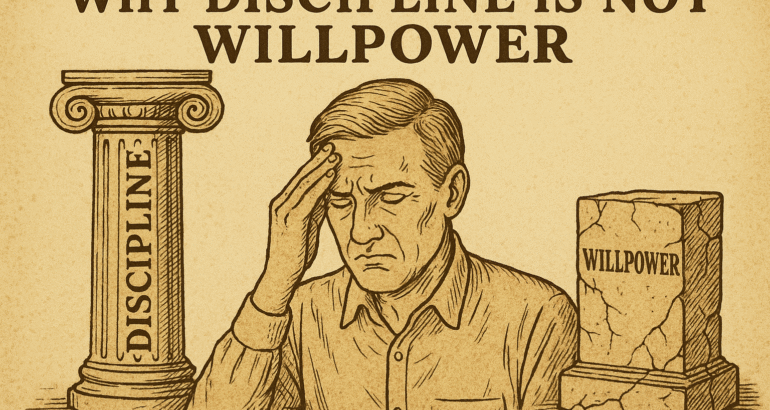
At some point in a trader’s journey, discipline stops feeling like a solution and starts feeling like a burden. In the early days, discipline sounds empowering. It feels like the missing ingredient. Traders believe that once they become disciplined enough, everything else will fall into place.
But as time passes, something unsettling happens.
The trader tries harder. He tightens rules. He reminds himself to stay focused. He promises not to repeat mistakes. And yet, discipline continues to break — sometimes subtly, sometimes catastrophically.
This is the stage where traders begin to doubt themselves deeply. They assume that consistent traders must possess a level of mental strength or self-control that they lack. They believe the problem is inside them.
This belief is not only wrong — it is destructive.
Because discipline, in trading, is not a personal trait.
It is a structural outcome.
And until a trader understands this, consistency will always feel fragile.
The Dangerous Myth That Discipline Is a Character Trait
Most trading education frames discipline as a matter of character. You are either disciplined or you are not. If you fail, it means you were careless, lazy, impulsive, or weak.
This framing feels logical because that’s how discipline works in many areas of life. If you don’t study, you fail an exam. If you don’t train, you lose fitness. Effort and discipline are directly rewarded.
Trading does not work this way.
In trading, effort is often punished. Discipline is often tested at the worst possible moments. And the same disciplined behavior can lead to wildly different outcomes depending on market conditions.
When traders internalize the idea that discipline is a personality trait, they begin to interpret every mistake as a personal flaw. Over time, this creates shame, self-doubt, and emotional fatigue.
Professional traders do not see discipline this way. They understand something retail traders rarely do:
Discipline is not something you bring to the market.
It is something the market environment either allows or destroys.
Why Willpower Fails in Live Trading Environments
Willpower is a limited resource. It depletes with use. It weakens under stress. It collapses under uncertainty.
Trading environments are designed to exhaust willpower.
Every moment in the market demands decisions:
- Should I enter now?
- Should I wait?
- Is this setup good enough?
- Should I reduce size?
- Should I take another trade?
- Should I stop for the day?
Each decision drains cognitive energy. As mental energy drops, impulse control weakens. This is not failure. It is biology.
This is why traders often start the day disciplined and end it reckless. This is why rules break late in sessions. This is why mistakes cluster.
Professional traders do not rely on willpower to survive this environment. They engineer systems that reduce the need for willpower altogether.
Discipline Breaks Not Because You Don’t Care — But Because You Care Too Much
This is an uncomfortable truth.
Many traders assume discipline fails because they lack seriousness. In reality, discipline often fails because traders are emotionally invested.
They care deeply about outcomes. They want to recover losses. They want to validate effort. They want to prove competence. This emotional investment increases internal pressure.
Pressure narrows perception. It speeds up decision-making. It increases reactivity.
Under pressure, discipline feels restrictive. The mind starts negotiating rules instead of following them.
Professional traders minimize emotional pressure by lowering the psychological stakes of each decision. Retail traders increase pressure by attaching meaning to outcomes.
The Difference Between Rule-Based and Choice-Based Trading
This distinction alone explains why discipline collapses for most traders.
Rule-based trading removes choice.
Choice-based trading demands discipline.
Every time a trader must decide whether to follow a rule, discipline is required. And discipline, when used repeatedly, depletes.
Professional traders do not decide whether to follow rules. The rules are embedded into their process so deeply that there is nothing to decide.
Retail traders leave choices open and then blame themselves for not choosing correctly under pressure.
This is not a mindset issue.
It is a design flaw.
Why Discipline Collapses During Winning Streaks
One of the most misunderstood aspects of discipline is that it often breaks after success, not failure.
Winning creates confidence. Confidence reduces perceived risk. Reduced risk perception weakens rule adherence.
Traders start to believe:
- “I understand the market now”
- “I can be flexible”
- “I don’t need to be so strict”
This flexibility feels mature. It feels intuitive. It is usually the beginning of the next drawdown.
Professional traders become more rigid during winning periods, not less. They treat confidence as a warning signal, not a green light.
Retail traders relax discipline when things feel easy. Professionals tighten structure when results improve.
Why Discipline Advice Sounds Good but Fails in Practice
Advice like “be patient,” “stay disciplined,” or “control emotions” sounds helpful but lacks operational clarity.
These statements do not reduce decision load.
They do not change environment.
They do not alter cognitive pressure.
They place responsibility entirely on the trader’s internal strength.
Professional environments — aviation, medicine, military operations — do not rely on motivation or discipline slogans. They rely on checklists, constraints, and redundancy.
Trading, despite being equally high-stakes, is often approached like a self-control experiment.
This mismatch is costly.
Discipline Is a System Output, Not a Moral Virtue
This is the shift that changes everything.
Discipline is not something you force.
It is something that emerges naturally when:
- Risk is predefined
- Trade frequency is limited
- Decision windows are fixed
- Stop conditions are absolute
- Shutdown rules are enforced
In such environments, discipline feels effortless. Not because the trader is stronger, but because the system does the heavy lifting.
Retail traders admire disciplined individuals.
Professional traders admire well-designed systems.
Why Traders Resist Structure (Even When It Works)
Structure feels boring.
Structure feels restrictive.
Structure feels limiting.
Many traders equate freedom with opportunity. They believe more discretion leads to better performance.
In reality, discretion increases cognitive load and emotional exposure. Structure reduces both.
Professional traders understand that freedom in trading is dangerous. Constraints protect performance.
Retail traders resist structure because it feels like giving up control. In reality, structure restores control.
The Hidden Link Between Discipline and Decision Fatigue
Decision fatigue quietly erodes discipline.
As the day progresses:
- Judgment weakens
- Impulses strengthen
- Rules feel negotiable
Traders believe they are choosing poorly. In reality, their brain is exhausted.
Professional traders protect discipline by limiting decision exposure. Retail traders expose themselves endlessly and expect discipline to hold.
This expectation is unrealistic.
Why Over-Monitoring Destroys Discipline
Watching every price movement creates emotional volatility. Each fluctuation demands interpretation. Each pullback triggers anxiety.
This constant monitoring drains discipline faster than anything else.
Professional traders monitor outcomes less and structure more. Retail traders monitor everything and structure little.
Discipline survives when attention is conserved.
The Role of Identity in Discipline Failure
Discipline collapses fastest when trading becomes tied to identity.
When breaking a rule feels like personal failure, emotional pressure increases. When following rules feels like self-validation, pressure also increases.
Both states distort behavior.
Professional traders separate identity from execution. Retail traders merge them.
Once identity is attached, discipline becomes emotionally loaded and fragile.
Why Discipline Improves in Simulation but Fails Live
In simulation:
- No money is at risk
- No identity is threatened
- No emotional consequence exists
Discipline improves automatically.
This reveals the truth: discipline is not missing. It is suppressed by pressure.
Professional traders design live environments that resemble simulation in structure, even if stakes are real.
Retail traders accept emotional chaos as normal.
The Structural Shift That Stabilizes Discipline
Discipline stabilizes when:
- The number of trades is capped
- Risk per trade is fixed
- Session start and end times are rigid
- Loss limits trigger automatic shutdown
- Rules are binary, not interpretive
This removes negotiation.
This removes self-debate.
This removes emotional bargaining.
Discipline becomes automatic.
Why Discipline Should Feel Boring
If discipline feels intense, it is unstable.
True discipline feels repetitive, predictable, and emotionally neutral.
Professional traders are not excited by discipline. They barely notice it. That’s how you know it’s working.
Retail traders seek excitement and then wonder why discipline fails.
The Long-Term Cost of Discipline Misunderstanding
When traders believe discipline is about willpower, they:
- Blame themselves unnecessarily
- Lose confidence over time
- Quit prematurely
- Abandon viable strategies
Understanding discipline structurally prevents years of emotional damage.
FAQ
Why can I be disciplined some days and reckless on others?
Because discipline depends on cognitive load, not character.
Is discipline a skill that can be trained?
Only indirectly, by redesigning decision environments.
Why does discipline collapse under pressure?
Because pressure exhausts willpower.
Do professional traders have stronger discipline?
No. They rely less on discipline.
What’s the fastest way to improve discipline?
Remove unnecessary decisions.
Final Thought: Stop Trying to Be Disciplined
Discipline is not a virtue test.
It is a design problem.
If your trading requires constant self-control, something is wrong with the structure — not you.
At mavianalytics.com, we don’t teach traders to fight themselves.
We teach them to build systems where discipline is no longer required.
Because consistency does not come from strength of mind.
It comes from strength of structure.