

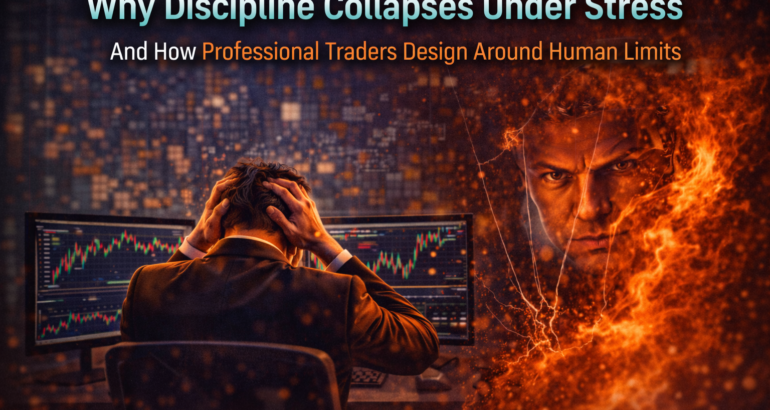
And How Professional Traders Design Around Human Limits
Most traders believe discipline is something they either have or don’t have. When they break rules, they assume something is wrong with them. They blame emotions, lack of experience, or weak mindset. They promise to “be more disciplined next time.”
But discipline in trading does not fail because traders are careless or flawed.
It fails because trading places human decision-making under conditions it was never designed to handle continuously.
To understand why discipline collapses, we must stop treating it as a personality trait and start understanding it as a fragile human function that changes under pressure.
Why Traders Feel Disciplined One Day and Reckless the Next
Most traders have experienced this contradiction.
On some days, they follow rules effortlessly. They wait patiently. They exit cleanly. Losses don’t disturb them much. Decisions feel clear.
On other days, using the same strategy, everything breaks. They overtrade. They hesitate. They chase. They break rules they fully understand.
The market did not suddenly become harder.
The trader did not suddenly become stupid.
What changed was internal capacity.
Human self-control is not constant. It fluctuates based on stress, fatigue, emotional load, and cognitive demand. Trading quietly drains these resources over time.
What Stress Actually Does to a Trader’s Brain
Stress is not just an emotion. It is a biological state.
When stress rises, the brain shifts priority. It becomes focused on speed, certainty, and immediate resolution. Long-term thinking weakens. The ability to wait reduces. Risk perception distorts.
In this state, the trader does not choose to break rules. The brain simply becomes less capable of holding abstract plans while reacting to immediate stimuli.
This is why discipline collapses predictably during:
- losing streaks
- late trading hours
- high volatility
- emotional swings
- mental fatigue
This is not a moral failure. It is a neurological one.
Why “Just Try Harder” Always Fails
When traders notice discipline slipping, they usually respond with effort.
They tighten up. They promise themselves they will behave. They push through discomfort.
This works briefly, because willpower can override impulses for short periods. But willpower is not infinite. It exhausts quickly under uncertainty and repetition.
The harder a trader relies on willpower, the more violent the eventual collapse becomes.
Professional traders learned a painful truth early:
Any system that depends on constant self-control will eventually fail.
Why Discipline Breaks Late in the Day
Discipline rarely fails on the first trade.
It fails on the fourth, sixth, or tenth decision.
Each decision consumes mental energy:
- Should I enter?
- Should I exit?
- Should I hold?
- Should I adjust?
By the end of the session, the trader is mentally depleted, even if they don’t consciously feel tired. At that point, restraint becomes harder than action.
This is why late trades are usually worse than early ones — not because the setups changed, but because the trader’s capacity changed.
Why Emotional Control Is the Wrong Goal
Many traders believe discipline requires emotional neutrality.
This is unrealistic.
Professionals still feel fear, excitement, frustration, and confidence. The difference is that their systems do not depend on emotional stability to remain safe.
Expecting yourself to feel calm before acting is fragile. Designing a system that remains safe even when emotions are unstable is robust.
Markets reward robustness.
How Identity Quietly Weakens Discipline
Discipline collapses faster when trading becomes personal.
When traders tie their identity to performance, mistakes feel embarrassing. Losses feel like personal failure. Rule-breaking creates shame, which triggers defensiveness rather than correction.
Once ego enters the picture, discipline becomes harder to restore because the trader is no longer managing risk — they are managing self-image.
Professionals separate discipline from identity. Rules are not proof of intelligence or professionalism. They are operational safeguards.
Breaking a rule is not a character flaw.
It is information.
Why Confidence Can Be Dangerous Under Stress
Stress does not always make traders fearful. Sometimes it makes them confident.
Under pressure, the brain seeks certainty. Conviction increases. Doubt decreases. Trades feel “obvious.”
This confidence is not insight.
It is the brain simplifying reality to reduce discomfort.
This is why traders often feel strongest right before their worst decisions.
Professionals treat confidence spikes as warning signs, not confirmations.
Why Plans Fail Without Structure
Traders are often told to “just follow the plan.”
Plans are abstract. Markets are dynamic.
Under stress, abstract rules lose authority unless they are enforced structurally. Memory and intention are unreliable when emotional load is high.
Professionals embed plans into constraints.
They decide in advance:
- how many trades are allowed
- how much risk is acceptable
- when trading stops
- what cannot be adjusted
This removes the need for discipline in the moment.
Discipline Is Not Saying No — It’s Removing the Choice
Every choice creates temptation.
The more discretion a trader has, the more discipline is required to stay safe. This is why discretionary systems break more often than rule-based ones.
Professionals aggressively reduce choice.
They do not ask themselves whether they should continue trading. The system already decided.
This is not rigidity.
It is protection.
Why Fewer Rules Improve Discipline
Many traders add rules to improve control. This backfires.
Complex systems increase mental load. Under stress, traders forget rules, reinterpret them, or selectively ignore them.
Professionals keep rules few, simple, and non-negotiable. The goal is not sophistication. It is executability when pressure is high.
Why Discipline Often Breaks After Success
Success lowers perceived risk.
When traders feel safe, they loosen constraints. They increase size, extend hours, and allow flexibility.
This is when discipline is most vulnerable.
Professionals tighten discipline after winning phases, not loosen it. They understand that confidence is when structure matters most.
Discipline Is a System Problem, Not a Personality Problem
The most important shift a trader can make is this:
Stop asking
“Why am I not disciplined?”
Start asking
“Is my system demanding more discipline than a human can reliably provide?”
That question changes everything.
Environment Shapes Discipline More Than Intention
Discipline is influenced by environment:
- constant screen exposure
- notifications
- social media
- trading access
Professionals design environments that reduce impulsive triggers. Retail traders expose themselves to noise and then blame emotions.
Environment always wins.
Why Trading Less Improves Discipline
Fewer trades mean fewer decisions.
Fewer decisions preserve mental energy. Preserved energy sustains self-control.
This is why many traders become disciplined only after reducing frequency — not because they matured, but because the system became survivable.
Discipline Cannot Be Fixed Mid-Crisis
Once stress peaks, discipline cannot be restored instantly.
Trying to calm down mid-trade rarely works. The brain is already reactive.
Professionals focus on prevention, not recovery:
- stopping early
- stepping away
- cutting exposure
Discipline is protected in advance, not repaired in real time.
Long-Term Discipline Is About Sustainability
The goal is not perfect execution today.
The goal is acceptable execution for years.
This requires respecting human limits rather than fighting them.
Professionals aim to be durable, not heroic.
Final Thought (explained, not quoted)
Discipline does not survive because a trader is strong.
It survives because the system does not ask the trader to be strong all the time.
When discipline is engineered into structure, traders stop fighting themselves and start managing reality.
That is how consistency is built — quietly, slowly, and sustainably.