

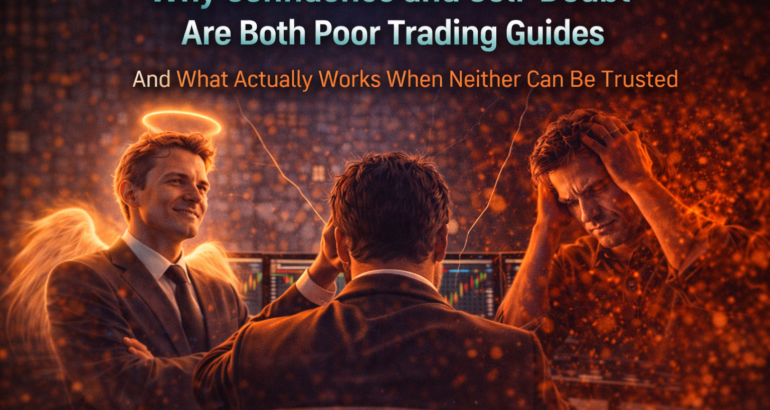
And What Actually Works When Neither Can Be Trusted
Most traders believe their biggest challenge is emotional balance. They think they must become confident to trade well and eliminate self-doubt to stop making mistakes. When confidence is high, they feel capable. When self-doubt appears, they feel broken.
This belief creates an endless internal struggle. Traders swing between confidence and doubt, hoping one will finally stabilize and carry them to consistency.
But both confidence and self-doubt are unreliable guides in trading. They change too quickly, they respond to recent outcomes, and they have little relationship with actual risk or expectancy. Traders who follow either of them end up making inconsistent decisions even when they know better.
This chapter explains why confidence and self-doubt mislead traders, how both quietly distort behavior, and what professionals rely on instead when emotions cannot be trusted.
Why Traders Chase Confidence in the First Place
Confidence feels like clarity. When traders are confident, decisions feel easier. Entries feel natural. Risk feels manageable. The mind stops questioning itself. This relief is powerful, especially after periods of hesitation or losses.
Many traders assume that if they could just stay confident, discipline would follow automatically. They believe confidence creates good behavior.
In reality, confidence is usually a reaction, not a foundation. It rises after wins and fades after losses. It reflects recent outcomes more than skill or market conditions.
This is why confidence feels strong right before mistakes and disappears when it is needed most.
How Confidence Quietly Distorts Risk
When confidence increases, perceived risk decreases. Trades feel safer than they actually are. Position size increases slightly. Stops feel flexible. Rules begin to feel optional rather than necessary.
This does not happen because traders consciously decide to take more risk. It happens because confidence changes perception. The market looks easier. Outcomes feel more predictable. Uncertainty fades into the background.
The trader is not trying to be reckless. They simply no longer feel the danger.
This is why some of the worst drawdowns happen after winning streaks, not losing ones.
Why Confidence Makes Traders Trust Feelings Over Structure
As confidence grows, traders begin relying more on intuition and less on rules. They start believing they can sense the market better. They justify deviations because they “feel right.”
This shift is subtle. The trader still believes they are disciplined. They still believe they are managing risk. But decisions slowly move from structure to feeling.
Markets do not respond to how confident a trader feels. They respond to exposure. When exposure grows quietly under confidence, losses become larger and more confusing when they arrive.
Why Self-Doubt Feels So Crippling
Self-doubt feels like the opposite of confidence, but it creates its own distortions.
When traders doubt themselves, decisions feel heavy. Entries feel risky. Losses feel threatening. Even good setups look dangerous.
Self-doubt narrows perception. Traders focus more on what could go wrong than on whether the trade fits their system. They hesitate, skip valid trades, or exit early to escape discomfort.
This behavior feels cautious, but it often damages expectancy just as much as overconfidence does.
How Self-Doubt Leads to Inconsistent Execution
A trader in self-doubt rarely follows rules cleanly. They may enter late, exit early, or second-guess signals. The system remains intact on paper, but execution becomes distorted.
What makes this dangerous is that self-doubt often appears after losses, exactly when discipline matters most. The trader does not trust themselves enough to execute properly, so results worsen, reinforcing the doubt.
This creates a feedback loop that can last for months.
Why Confidence and Self-Doubt Are Two Sides of the Same Problem
Confidence and self-doubt seem like opposites, but they share the same flaw: both are emotion-based signals reacting to recent outcomes.
Neither reflects true risk.
Neither reflects long-term expectancy.
Neither reflects structural safety.
They are short-term psychological weather, not navigation tools.
Trading decisions guided by emotional states will always fluctuate, because emotional states fluctuate.
Why Trying to “Fix” Confidence Never Works Long-Term
Many traders try to engineer confidence. They use affirmations, visualization, motivational content, or mental tricks. These methods may boost confidence temporarily, but the effect fades quickly when the next loss arrives.
Confidence built on emotion collapses under pressure because it lacks structure. It depends on feeling good rather than behaving correctly.
Professionals do not try to maintain confidence. They design systems that do not require confidence to function safely.
What Professionals Trust Instead of Confidence
Professional traders do not ask themselves how they feel before acting. They ask whether conditions meet predefined criteria.
They rely on:
– position sizing that limits damage
– rules that do not change with mood
– predefined exits
– time-based and exposure-based limits
This structure remains valid whether the trader feels confident, uncertain, tired, or frustrated.
Confidence becomes irrelevant.
Why Doubt Is Not the Enemy Either
Self-doubt is uncomfortable, but it is not always harmful. Doubt can signal that risk is being perceived more accurately. The problem arises when doubt controls behavior instead of informing structure.
Professionals allow doubt to exist without acting on it. They do not try to eliminate it. They recognize that doubt is part of operating in uncertainty.
The mistake retail traders make is believing doubt means they should stop trusting their system.
The Shift From Emotional Guidance to Process Guidance
The turning point in a trader’s development comes when they stop asking, “How do I feel about this trade?” and start asking, “Does this trade meet my rules?”
This shift removes emotion from the decision loop without requiring emotions to disappear.
The trader does not become fearless.
They become less reactive.
Why Neutrality Is a Better Goal Than Confidence
Professional traders aim for emotional neutrality. They want trading to feel slightly boring. When trades feel exciting or frightening, it usually means perception is being distorted.
Neutrality allows consistent execution. It keeps behavior stable across wins and losses.
This does not mean traders feel nothing. It means feelings are no longer trusted as decision signals.
How Confidence and Doubt Affect Position Size
One of the clearest places confidence and doubt cause damage is position sizing.
Confidence encourages traders to increase size when risk is often rising.
Doubt encourages traders to reduce size when opportunity may actually be valid.
Both lead to misaligned exposure.
Professionals size trades based on risk parameters, not emotional states. Size does not change because of recent wins or losses. This protects the equity curve from emotional swings.
Why Emotional Stability Does Not Mean Emotional Absence
Many traders believe professionals feel calm all the time. This is not true.
Professionals still experience confidence, doubt, fear, and excitement. The difference is that these feelings are not allowed to shape decisions.
Emotions are observed, not obeyed.
This is where earlier meta-thinking skills become critical. Awareness allows feelings to exist without control.
How Traders Slowly Learn to Distrust Their Feelings
Over time, traders who survive notice patterns. They see that confidence often appears before mistakes and doubt often appears after losses. They stop treating feelings as reliable indicators.
This realization is uncomfortable at first. Trusting feelings feels natural. Distrusting them feels cold or mechanical.
But this shift is what creates consistency.
Why Consistency Emerges When Feelings Lose Authority
Consistency does not come from perfect psychology. It comes from stable behavior across unstable internal states.
When confidence and doubt no longer decide actions, execution becomes cleaner. Results stabilize. Emotional swings reduce naturally because outcomes stop feeding identity.
The trader becomes less fragile.
The Long-Term Cost of Emotional Decision-Making
Traders who continue relying on confidence and doubt often experience chronic inconsistency. They oscillate between periods of strong performance and sudden collapses. They feel confused about why results change.
The cause is not the market.
It is emotional guidance masquerading as intuition.
What Actually Guides Sustainable Traders
Sustainable traders are guided by:
– predefined structure
– risk limits
– behavioral rules
– awareness of internal states
– acceptance of uncertainty
These elements remain stable regardless of mood.
Confidence becomes optional.
Doubt becomes manageable.
Final Thought (Explained Clearly)
Confidence feels good, but it lies.
Self-doubt feels bad, but it lies too.
Neither understands probability.
Neither respects risk.
Traders who last do not follow how they feel.
They follow what is structurally safe, even when feelings disagree.
When decisions stop depending on confidence or doubt, trading becomes steadier, calmer, and survivable.
That is not emotional mastery.
It is psychological maturity.