

How Rule-Following Slowly Becomes the Enemy of Good Trading
Most traders believe discipline is always a good thing. They are told that discipline is the solution to emotional mistakes, impulsive trades, and inconsistent results. When they struggle, they promise themselves to become more disciplined. When they improve, they credit discipline for the change.
This belief is mostly correct—but incomplete.
Discipline helps traders survive early chaos. It creates structure where there was randomness. It replaces impulse with rules. It protects capital when emotions are strong. Without discipline, very few traders last long enough to learn anything meaningful.
But there is a phase in trading where discipline, if left unquestioned, quietly turns into rigidity. And rigidity does not protect traders. It traps them.
This chapter explains how discipline slowly hardens into rigidity, why this transition is so hard to notice, and why some of the most rule-following traders end up stuck or declining despite doing “everything right.”
In the early stages of trading, discipline feels liberating. Before rules, every decision feels heavy. Traders second-guess themselves constantly. They enter late, exit early, and overtrade because nothing feels anchored.
When rules arrive, pressure reduces. Decisions feel simpler. The trader no longer negotiates with every impulse. Risk becomes contained. Progress appears.
This phase creates a powerful association: rules equal safety.
Over time, that association becomes unquestioned.
As traders gain experience, they rely more and more on the systems that helped them stabilize. Rules become familiar. Processes become routine. What once required effort now feels automatic.
At this stage, discipline stops feeling like something the trader uses. It becomes something the trader is.
“I am a disciplined trader.”
“I follow my rules.”
“This is what keeps me safe.”
This identity feels earned. It also becomes fragile.
Rigidity begins when traders stop distinguishing between structure and adaptation.
Markets are dynamic. Volatility changes. Participation changes. Regimes shift. What worked cleanly in one environment may still work in another—but often with different frequency, rhythm, or risk characteristics.
Rigid traders do not notice these subtleties. They continue executing rules exactly as before, even when feedback quietly changes.
Losses increase slightly. Win rates dip modestly. Drawdowns last longer than expected.
Because the rules are being followed, the trader assumes the problem must be temporary.
One of the clearest signs that discipline has turned into rigidity is defensive rule-following.
When trades fail, the trader responds by pointing to the rules rather than examining outcomes. They say things like, “I followed my plan, so it’s fine,” even when results consistently deteriorate.
Following rules becomes a shield against self-reflection.
This is not dishonesty. It is protection. Questioning the rules feels like questioning the very thing that saved the trader earlier.
Rigid discipline also shows up as fear of adjustment.
Any suggestion to modify risk, reduce frequency, or rethink assumptions feels threatening. The trader worries that change will reopen emotional chaos. They fear slipping back into inconsistency.
So they stay rigid, even as performance erodes.
They are no longer using discipline to manage risk. They are using it to manage fear.
Another subtle sign of rigidity is loss of curiosity.
Early in development, traders ask many questions. They explore what works and why. Later, rigid traders stop asking questions because answers feel settled.
They know their setups. They know their rules. They know their edge.
Curiosity fades. Review becomes mechanical. Journaling records outcomes but not insight.
When curiosity disappears, learning stops. When learning stops, edge decays.
Rigid discipline often disguises itself as professionalism.
From the outside, the trader looks controlled, consistent, and serious. They do not overtrade. They do not revenge trade. They do not chase moves.
But inside, something feels off.
Trading feels heavy. Results stagnate. The trader feels like they are working harder for less. They sense friction but cannot explain it.
Because behavior looks correct, they assume the problem must be psychological endurance rather than strategic alignment.
Another way rigidity shows up is over-respecting rules during changed conditions.
Rules are built based on assumptions about volatility, liquidity, and behavior. When those assumptions drift, rigid traders continue applying rules without recalibration.
Stops that were once appropriate become too tight. Targets that once made sense become unrealistic. Frequency that once fit the market becomes excessive.
The trader follows rules perfectly—and bleeds slowly.
Rigid traders also struggle with exceptions, even when exceptions are justified.
Markets occasionally present situations that technically meet rules but clearly feel low quality. Flexible traders reduce size or skip the trade. Rigid traders take it because “the rules say so.”
They confuse consistency with obedience.
Consistency is about behavior aligned with intent. Obedience is about execution without judgment. Trading requires the former, not the latter.
Another psychological cost of rigidity is delayed feedback processing.
Flexible traders adjust when patterns repeat. Rigid traders wait longer because rules give them permission to ignore discomfort.
They tell themselves, “This system has drawdowns,” even when drawdowns exceed historical expectations.
By the time they respond, damage is deeper and confidence weaker.
Rigid discipline also interferes with self-trust.
Ironically, traders who rely too heavily on rules stop trusting their own perception. They silence intuition entirely, even when intuition is signaling something important.
This is dangerous because intuition, when informed by experience, often detects changes before metrics do.
Healthy trading integrates structure with awareness. Rigid trading suppresses awareness in favor of certainty.
Many traders become rigid after surviving emotional pain.
If a trader once blew up or lost heavily due to impulsive behavior, discipline feels like armor. Any movement away from strict rules feels unsafe.
This trauma response is understandable—but limiting.
Rigid discipline protects against chaos, but it also blocks growth.
Professional traders recognize this risk and actively guard against it.
They treat rules as tools, not commandments. They review assumptions regularly. They allow controlled flexibility within defined boundaries.
They understand that discipline is meant to serve adaptability, not replace it.
The shift from rigidity back to healthy discipline is uncomfortable.
It requires traders to question things that once felt sacred. It requires admitting that rules need refinement. It requires tolerating uncertainty again.
Many traders resist this phase because it feels like going backward.
In reality, it is moving to a higher level of understanding.
Healthy discipline evolves.
Early discipline focuses on restraint.
Later discipline focuses on alignment.
Early discipline says, “Don’t break rules.”
Mature discipline says, “Make sure rules still make sense.”
This evolution separates survivors from stagnators.
When discipline becomes flexible again, trading lightens.
Decisions feel clearer. Adjustments feel rational rather than emotional. The trader regains a sense of participation rather than compliance.
They are no longer hiding behind rules. They are working with them.
Rigid traders often believe flexibility equals danger.
Experienced traders learn that unexamined rigidity is the real danger.
Markets punish those who cannot adapt quietly, not those who make occasional mistakes.
The goal is not to abandon discipline.
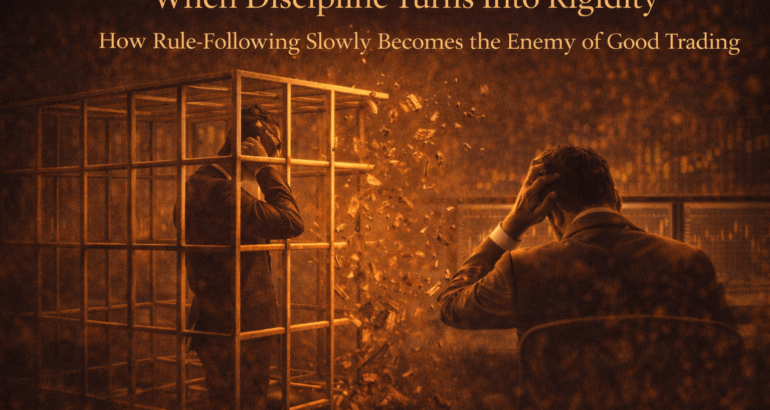
The goal is to prevent discipline from turning into a cage.
Rules should support awareness, not suppress it. Structure should guide behavior, not freeze it.
When traders find this balance, discipline becomes sustainable again.
They respect rules without worshipping them. They adjust without panicking. They remain structured without becoming blind.
This balance is rare because it cannot be taught early. It only appears after discipline has done its job—and then been questioned.
Many traders never reach this phase.
They either remain undisciplined forever, or they become rigid and stall.
Those who pass through rigidity without getting stuck emerge with something far more valuable than discipline alone.
They emerge with judgment.
Judgment is what allows traders to stay disciplined and adaptive at the same time.
It is quiet. It is unglamorous. It cannot be automated.
But it is what keeps traders alive when conditions change.
Discipline gets traders into the game.
Judgment keeps them there.
Those who mistake one for the other often disappear without knowing why.