

The Trader’s Mental Operating System: Why Knowing More Never Fixes Losing (and What Actually Does)
There is a stage in every serious trader’s journey where confusion becomes heavier than ignorance. In the beginning, not knowing feels honest. You accept mistakes easily because you expect them. But later, after years of learning, reading, watching, and practicing, losses begin to hurt differently. They no longer feel like tuition. They feel like betrayal.
You know what you’re doing. At least, you think you do. You understand charts. You understand indicators. You understand risk management in theory. And yet, when real money is on the line, something keeps breaking down.
You hesitate when you should act.
You act when you should wait.
You override plans you carefully created.
You repeat mistakes you swore you’d never make again.
At this point, most traders assume they need more knowledge. Another strategy. Another confirmation tool. Another course. Another perspective. But the truth is far more uncomfortable.
Your problem is not knowledge.
Your problem is that you don’t have a mental operating system built for uncertainty.
This blog is about that operating system.
Why Learning More Often Makes Traders Worse
This may sound counterintuitive, but many traders become less consistent as they learn more. Not because learning is bad, but because learning without structure creates internal conflict.
Each new concept adds another voice in your head. One strategy says buy. Another says wait. One indicator confirms. Another contradicts. When price moves fast, your brain tries to reconcile all of them in real time. It can’t.
What you experience as “hesitation” or “overthinking” is actually decision collision.
Professionals don’t know less than you.
They know what to ignore.
They operate with a hierarchy of decisions. You operate with a pile of information.
The Invisible Problem No One Teaches: Cognitive Load in Trading
Every human brain has a limited capacity for decision-making under pressure. Trading constantly pushes that capacity to its limits. Price movement, time pressure, money at risk, and uncertainty all combine into a high-stress environment.
When your cognitive load exceeds capacity, your brain defaults to emotion-driven shortcuts:
- Fear-based exits
- Hope-based holding
- Impulse-based entries
This is not a discipline problem.
It is a design problem.
You are trying to run complex decisions without a system designed to handle them.
The Illusion of Control That Quietly Destroys Traders
Most traders believe that if they can just understand the market deeply enough, they will gain control over outcomes. This belief feels logical. It is also false.
Markets do not reward control.
They reward alignment with probability.
The more you try to control outcomes, the more emotionally involved you become. And emotional involvement reduces objectivity. This creates a paradox where intelligence becomes a liability.
Professional traders are not trying to control the market.
They are trying to control themselves within the market.
That is a completely different goal.
Why Strategy-Focused Traders Collapse Under Pressure
Strategies are static. Markets are dynamic.
A strategy learned in calm conditions feels robust. But under live conditions, when price moves against you and money is at risk, strategy alone offers no guidance for how to behave.
This is why traders break rules even when they know better. The strategy didn’t tell them what to do emotionally.
Professionals don’t rely on strategies to guide behavior.
They rely on predefined decision frameworks.
Frameworks don’t predict.
They constrain behavior.
The Missing Layer: Decision Architecture
Every professional trader operates with an internal decision architecture, whether they consciously realize it or not. This architecture answers questions automatically:
- When do I act?
- When do I wait?
- When do I stop?
- When do I reduce risk?
- When do I step aside entirely?
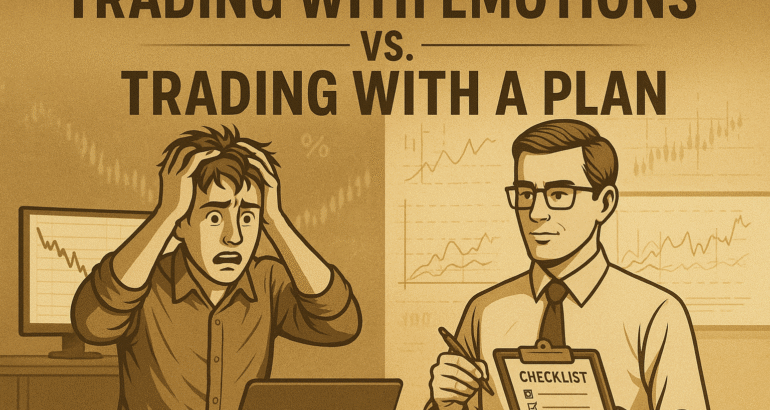
Retail traders answer these questions emotionally, in real time. Professionals answer them before the trade ever exists.
This is why professionals appear calm.
They are not deciding in the moment.
They are executing decisions already made.
Why Emotional Control Is the Wrong Goal
Many traders try to “control emotions.” This almost always fails.
You cannot suppress fear or greed reliably. Emotions are not bugs. They are signals. The real issue is that emotions are being allowed to make decisions.
Professionals don’t try to eliminate emotion.
They design systems where emotion has no voting power.
Emotion may speak.
It does not decide.
Identity Conflict: The Silent Reason Traders Self-Sabotage
Here is something rarely discussed: many traders have an identity conflict. They want to see themselves as disciplined, intelligent, and rational. But their actions under pressure contradict this identity.
This creates internal tension. To resolve it, the mind rationalizes bad behavior:
- “This time is different.”
- “The market is irrational.”
- “I’ll just adjust the stop.”
These are not mistakes.
They are identity defenses.
Professional traders redefine their identity around process, not outcomes. They are not “good traders” because they win. They are good traders because they execute correctly regardless of outcome.
The Confidence Decay Cycle
Confidence in trading doesn’t disappear suddenly. It erodes quietly.
A few small rule breaks.
A few emotional exits.
A few forced trades.
Each one slightly weakens trust in yourself. Eventually, even good setups feel uncomfortable. Hesitation increases. Execution quality drops. Losses follow. Confidence decays further.
Most traders try to rebuild confidence by winning again. This rarely works.
Professionals rebuild confidence by restoring behavioral integrity.
Confidence is not emotional.
It is structural.
Why Journaling Trades Is Not Enough
Many traders journal entries and exits. Few journal decision quality.
The real question after every trade is not “Did I make money?”
It is “Did I behave as planned?”
A losing trade with perfect execution strengthens your system.
A winning trade with poor execution weakens it.
Professionals optimize behavior first.
Money becomes a byproduct.
The Calm Trader Is Not Passive — They Are Decided
Calmness in trading is often misunderstood as passivity or lack of ambition. In reality, calm traders are deeply decided. They have already accepted uncertainty, losses, and randomness.
Because they are not fighting reality, they conserve mental energy. They don’t waste it on regret, hope, or blame.
Calm is not lack of emotion.
Calm is lack of internal conflict.
How to Begin Building a Mental Operating System
The goal is not to learn more. The goal is to reduce decision load.
This starts by clearly defining:
- What you trade
- When you trade
- When you do nothing
- How much you risk
- When you stop completely
Once these decisions are externalized into rules, the mind is freed from constant negotiation.
Trading becomes execution, not debate.
Why This Changes Everything Long-Term
When your mental operating system is aligned:
- Losses stop feeling personal
- Wins stop inflating ego
- Execution stabilizes
- Learning accelerates
- Stress reduces dramatically
You are no longer trying to beat the market.
You are trying to operate correctly within it.
That is a game you can actually win.
FAQ
Why do experienced traders still struggle?
Because experience without structure reinforces bad habits instead of correcting them.
Is mindset more important than strategy?
Mindset without structure is motivation. Structure without mindset is rigidity. Professionals combine both.
How long does it take to build a strong trading mindset?
Mindset shifts can happen quickly. Behavioral consistency takes months of deliberate practice.
Should I stop learning new strategies?
Not necessarily. But learning must follow structure, not replace it.
What is the biggest mistake traders make after years in the market?
Assuming the solution is external instead of internal.
Final Thought: Trading Is a Cognitive Discipline, Not a Technical One
Markets don’t defeat traders by being complex.
They defeat traders by exposing weak thinking under pressure.
If you keep adding tools without fixing how you decide, you will keep repeating the same cycle at a higher level of complexity.
At mavianalytics.com, our goal is not to make you smarter.
It is to make you structurally sound.
Because once your thinking is stable, everything else finally has a place to work.
This is where real traders are built.