

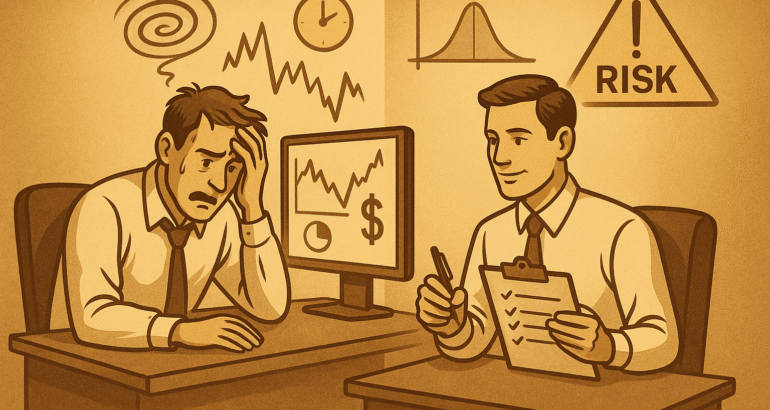
The Reality of Options Trading: Why Most Retail Traders Misunderstand Risk, Leverage, and Probability
Options trading attracts traders faster than any other market instrument. The promise looks irresistible. Limited capital. High leverage. Fast returns. Defined risk. Infinite strategies. On the surface, it feels like the most intelligent way to trade the markets.
Yet, if you look closely, options are where retail traders lose money the fastest and most consistently.
This creates confusion. If options are so flexible and powerful, why do so many traders struggle with them? Why do educated traders, even those who understand Greeks, strategies, and structures, still blow up accounts?
The answer is not lack of intelligence.
It is misunderstanding reality.
Options trading is not dangerous because of complexity.
It is dangerous because of false confidence.
This blog exists to remove that false confidence and replace it with clarity.
Why Options Feel Smarter Than They Actually Are
Options give traders a sense of control. You can define risk. You can choose probability. You can structure trades that seem mathematically elegant. This makes traders feel professional quickly, sometimes too quickly.
But options do not reduce uncertainty.
They repackage it.
Retail traders often mistake structure for safety. A defined-risk trade feels safe, even if the probability of success is low. A complex strategy feels intelligent, even if it is poorly understood.
Professional options traders don’t trade complexity.
They trade expectancy.
Retail traders trade possibility.
Professionals trade probability.
That distinction is everything.
Leverage: The Silent Psychological Multiplier
Leverage is often described mathematically. Few talk about its psychological effect.
Leverage does not just magnify profits and losses.
It magnifies emotion, impatience, and decision fatigue.
When small price movements cause large P&L swings, traders lose emotional stability. They begin watching trades tick by tick. They interfere. They over-manage. They exit early. They re-enter impulsively.
Options trading exposes emotional weaknesses faster than any other instrument. This is why traders feel “smart” initially and “broken” later.
Leverage doesn’t reveal skill.
It reveals discipline.
The Biggest Lie About Options: “Limited Risk”
Yes, options have defined risk on paper. But practical risk is behavioral, not mathematical.
A trader who:
- Overtrades
- Increases size emotionally
- Trades low-probability setups repeatedly
- Ignores volatility context
…does not have limited risk.
Defined-risk strategies give traders permission to take too many bad trades. Losses become frequent, and frequent losses damage psychology more than occasional large losses.
Professional traders don’t feel protected by limited risk.
They feel protected by selectivity.
Why Buying Options Feels Easy—and Destroys Capital
Option buying is attractive because:
- Losses are capped
- Gains feel unlimited
- Trades feel simple
But option buying introduces three hidden enemies:
- Time decay
- Volatility contraction
- Directional precision
Retail traders underestimate all three.
Buying options requires being right about direction, timing, and volatility simultaneously. Missing any one of these leads to loss. That’s a narrow window of success.
Professionals buy options rarely and intentionally.
Retail traders buy them frequently and emotionally.
Frequency kills expectancy.
Option Selling: Where Retail Traders Get Overconfident
After losing money buying options, many traders discover selling. Premium looks stable. Theta feels friendly. Win rates improve. Confidence returns.
Then comes the trap.
Option selling rewards traders until it doesn’t. When volatility expands suddenly or price moves aggressively, losses grow fast. Traders who sized too large or ignored tail risk face severe drawdowns.
The problem is not option selling.
The problem is selling without respect for risk distribution.
Professionals treat option selling like a business.
Retail traders treat it like income.
Income thinking leads to complacency.
Complacency leads to disaster.
Probability Is Not the Same as Edge
Many traders choose trades based on probability alone. A 70% probability trade feels good. A 90% probability trade feels even better.
But probability without payoff context is meaningless.
A high-probability trade with poor risk-reward can still have negative expectancy. This is why traders feel confused: they are “right” often but still lose money.
Professional options traders think in expected value, not win rate.
Expected value asks:
- How much do I make when I win?
- How much do I lose when I lose?
- How often do both occur?
Retail traders stop at probability.
Professionals go further.
Volatility: The Dimension Most Traders Ignore
Options are volatility instruments disguised as directional tools.
Many traders focus only on price direction. They ignore implied volatility, volatility expansion, and volatility contraction. This leads to confusion when correct direction still results in loss.
Volatility is not noise.
It is pricing.
Professionals know when to buy volatility and when to sell it. Retail traders react to it after damage is done.
Understanding volatility doesn’t require advanced math.
It requires respect for market conditions.
The “Strategy Collector” Problem in Options
Options traders are especially prone to strategy hopping. Iron condor today. Calendar spread tomorrow. Ratio spread next week. Each strategy feels like a solution to past pain.
But strategies don’t fix behavior.
Without discipline, position sizing, and execution control, every strategy becomes another way to lose money.
Professionals master a few structures deeply.
Retail traders collect many structures shallowly.
Depth creates edge.
Breadth creates confusion.
The Emotional Cost of Frequent Small Losses
One underrated danger of options trading is death by small losses.
Frequent small losses don’t hurt the account immediately. They hurt confidence. Traders begin forcing trades to recover. They widen risk. They lower standards.
Eventually, one large loss wipes out weeks of gains.
This cycle is common, predictable, and avoidable—but only if traders respect psychology as much as strategy.
The Professional Way to Think About Options
Professionals ask different questions:
- Is this trade necessary?
- Is volatility aligned with structure?
- Is risk acceptable even in worst-case scenarios?
- Would I still take this trade after three losses?
Options are not traded to feel busy.
They are traded when conditions justify complexity.
Most of the time, the best options trade is no trade.
How to Use Options Without Destroying Yourself
Options should be used to:
- Express defined views
- Control exposure
- Manage risk intelligently
- Improve portfolio behavior
They should not be used to:
- Chase excitement
- Compensate for impatience
- Recover losses quickly
- Replace discipline
When options serve process, they are powerful.
When they serve emotion, they are lethal.
FAQ
Are options suitable for beginners?
Only if beginners focus on risk control and learning, not income or excitement.
Is option selling safer than buying?
Neither is safe without discipline. Safety comes from behavior, not strategy type.
Can small accounts trade options successfully?
Yes, but only with strict selectivity and patience.
Why do options feel harder than stocks?
Because options expose timing, volatility, and psychology simultaneously.
Should I stop trading options if I keep losing?
Pause, review behavior, reduce size, and rebuild understanding before continuing.
Final Thought: Options Don’t Fail Traders — Traders Fail Reality
Options are honest instruments. They price risk transparently. They punish impatience. They reward preparation.
When traders lose money in options, it is rarely because of bad luck. It is because expectations were wrong.
At mavianalytics.com, we don’t teach options as shortcuts.
We teach them as precision tools that demand maturity.
If you respect reality, options can serve you.
If you chase illusion, they will expose you.
This blog is not meant to scare you away from options.
It is meant to make sure you survive long enough to master them.