

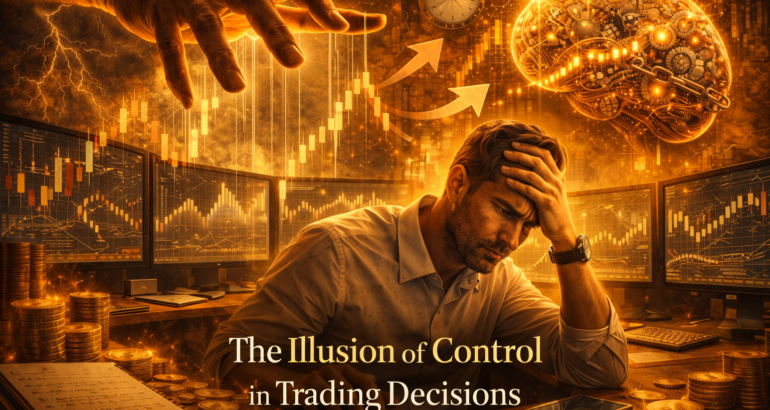
One of the most persistent feelings traders carry into the market is the sense that with enough effort, attention, or intelligence, outcomes can be influenced in real time. This belief rarely shows up explicitly. Traders don’t usually say, “I can control the market.” Instead, it appears subtly, inside actions that feel reasonable at the moment. Watching price more closely. Adjusting a stop “just a little.” Taking partial profits early. Adding confirmation. Waiting for one more candle. Entering late because the move looks strong.
All of these behaviors feel like refinement. They feel like skill being applied. But underneath them sits a quiet assumption: that closer involvement improves results.
This assumption is the illusion of control.
The illusion does not come from arrogance. It comes from how the human brain learned to survive. In most real-world situations, more attention does help. If you drive carefully, you avoid accidents. If you study more, you score higher. If you practice a skill, you improve. Effort and outcome are usually linked. The brain learns this relationship early and deeply. Trading violates it.
Markets are one of the few environments where increased involvement does not reliably increase outcome quality. In fact, it often does the opposite.
The illusion of control begins the moment a trader moves from preparation into live execution. Before the trade, everything feels structured. The setup makes sense. Risk is defined. The logic is clear. But once the position is live, uncertainty becomes real instead of theoretical. Price moves without explanation. Small fluctuations suddenly feel meaningful. The brain starts scanning for patterns, threats, and opportunities.
At this point, the trader is no longer operating on the plan alone. They are operating on continuous interpretation.
Interpretation creates the feeling of control because it creates activity. The trader feels involved. They feel responsive. They feel engaged with the market. This engagement feels productive, even when it isn’t. The brain mistakes activity for influence.
Consider how often traders adjust trades not because rules demand it, but because watching price creates discomfort. A candle closes weakly. Volume looks odd. The market hesitates. None of these invalidate the setup, but they introduce ambiguity. Ambiguity is uncomfortable. Doing something feels better than doing nothing. Adjustment feels like control.
This is where the illusion deepens. The trader believes they are managing risk, but what they are actually managing is internal tension.
The problem is not that traders want control. The problem is that they seek it in places where it does not exist.
Markets operate on probability, not responsiveness. A single trader’s actions have no causal impact on outcome. Once a trade is placed, the distribution of possible outcomes is already defined. Monitoring price does not change that distribution. Adjusting exits impulsively often worsens it. But the brain does not experience probability intuitively. It experiences immediacy.
Immediacy creates urgency. Urgency demands action. Action creates relief.
This cycle trains traders to believe that involvement equals effectiveness.
Another way the illusion of control shows up is in over-analysis after entry. Traders replay logic, search for confirmation, and look for reasons the trade “should” work. This behavior is often framed as confidence-building. In reality, it is an attempt to stabilize uncertainty. The brain dislikes holding exposure without narrative support. Stories feel like control because they make outcomes feel predictable.
When price moves against the trade, the story collapses. Stress rises. The trader scrambles for a new explanation. Maybe the market is manipulated. Maybe news is coming. Maybe the setup failed. Each explanation restores a temporary sense of understanding, which again feels like control.
None of this improves execution. It simply keeps the trader psychologically busy.
The illusion of control becomes even stronger after periods of success. When traders experience a run of profitable trades, they often attribute the results to judgment, timing, or intuition. This attribution feels natural. The brain prefers skill-based explanations over randomness. As confidence increases, so does involvement. The trader starts intervening more. They trust their read. They override exits. They size up selectively.
At this stage, rule-following begins to feel restrictive. Rules feel like training wheels. Control feels earned.
Eventually, variance returns. Losses appear. The trader is confused, not because losses happened, but because the sense of influence has been violated. Stress spikes. The trader increases involvement further, trying to “fix” what is going wrong. This is often when drawdowns accelerate.
The illusion of control is particularly dangerous because it survives evidence. Traders can see that their interference worsens results and still repeat it. This is not stupidity. It is conditioning. The brain has been rewarded emotionally for acting, even when acting was financially harmful. Relief becomes the reinforcement, not profit.
Another layer of the illusion appears in position sizing decisions. Traders often feel that adjusting size dynamically gives them control over risk. In theory, sizing should be systematic. In practice, it often reflects confidence, fear, or recent outcomes. After a win, size increases. After a loss, size decreases. These adjustments feel prudent. They feel responsive. But they usually introduce inconsistency.
Inconsistency reintroduces uncertainty. The trader now has to manage not just the trade, but the meaning of size. Every fluctuation feels heavier or lighter than expected. Emotional reactions intensify. The trader believes they are managing risk, but they are actually amplifying emotional variability.
Control also appears in the obsession with entries. Traders spend enormous energy trying to perfect timing, believing that better entries give them control over outcome. In reality, most strategies are far more sensitive to exits, sizing, and frequency than to entry precision. But entries are visible. They are actionable. They offer the illusion of mastery.
Once in the trade, control evaporates. Price does what it does. The trader feels exposed again.
This repeated rise and fall of perceived control creates exhaustion. The trader oscillates between confidence and helplessness. Between involvement and regret. Between action and self-criticism. None of this is random. It is the natural result of placing control expectations in a probabilistic environment.
Traders who eventually stabilize do not gain more control over markets. They relinquish the need for it.
This does not happen through philosophy. It happens through design.
When decision points are reduced, the illusion weakens. When exits are predefined and not monitored tick by tick, involvement drops. When size is fixed, emotional interpretation loses leverage. When fewer trades are taken, each one carries less identity weight. Control shifts from outcome to process.
Importantly, this feels uncomfortable at first. Less involvement feels like negligence. Not watching price feels irresponsible. Letting trades play out feels passive. The brain resists because it equates activity with safety. Over time, however, something changes. The trader notices that outcomes stabilize. Emotional swings reduce. Fatigue decreases.
Not because the trader became wiser, but because the brain stopped fighting a battle it could never win.
The illusion of control fades slowly, not when traders understand it intellectually, but when they experience that doing less actually reduces damage. They begin to see that most interventions were never about improving trades. They were about managing discomfort.
In live markets, control is not something to be exercised moment by moment. It is something to be embedded beforehand. Once exposure begins, the role of the trader is largely finished. Any attempt to reclaim control mid-trade usually signals that something earlier was left unresolved.
The market does not respond to effort. It responds to probability. Traders suffer when they confuse the two.