

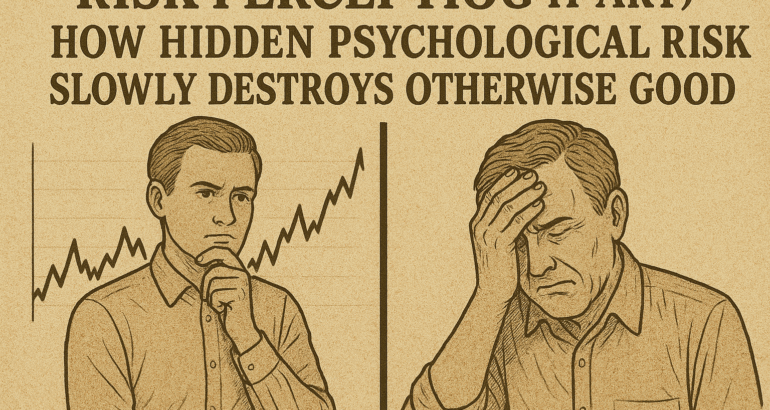
Risk Perception in Trading: Why Traders Fear the Wrong Things and Ignore the Real Danger
Every trader believes they understand risk. They talk about stop-losses, position sizing, drawdowns, and risk-reward ratios. Risk is one of the most discussed concepts in trading education. And yet, most traders fail not because they take too much risk—but because they perceive risk incorrectly.
This is one of the deepest and least understood problems in trading.
Risk in markets is not just mathematical. It is psychological, emotional, contextual, and deeply distorted by the human brain. Traders do not respond to actual risk. They respond to felt risk. And felt risk is rarely aligned with reality.
This blog is about that mismatch. Why traders fear the wrong moments, feel safe when they shouldn’t, and repeatedly expose themselves to the most dangerous form of risk without realizing it.
Why the Brain Is Bad at Understanding Market Risk
The human brain evolved to survive physical threats, not probabilistic environments. Risk perception developed in situations where danger was immediate, visible, and binary. You either escaped the predator or you didn’t. You either fell from the cliff or you didn’t.
Markets do not operate this way.
Market risk is:
- Delayed
- Abstract
- Non-linear
- Probabilistic
- Emotionally ambiguous
The brain struggles with this type of threat. As a result, it substitutes market risk with emotional discomfort. Whatever feels uncomfortable is labeled as risky. Whatever feels comfortable is labeled as safe.
This substitution is catastrophic for traders.
The Illusion of Safety During Winning Phases
One of the most dangerous moments in a trader’s career is not during losses—it is during periods of success.
Winning creates emotional safety. Emotional safety lowers perceived risk. Lower perceived risk leads to increased exposure.
Traders start:
- Increasing position size
- Loosening entry criteria
- Ignoring context
- Holding trades longer without justification
Nothing feels dangerous. The market feels friendly. The trader feels competent.
But this is when real risk is increasing.
Professional traders become defensive during winning streaks. Retail traders become aggressive.
This inversion explains why profits are often given back quickly.
Why Losses Feel Risky Even When They Are Not
Losses trigger pain. Pain signals danger to the brain. So the brain concludes that the current environment is risky.
But a losing trade is not necessarily dangerous. A losing trade executed within risk parameters is neutral. It is part of expectancy.
Yet traders respond to losses by:
- Reducing size excessively
- Hesitating on valid setups
- Avoiding participation
- Breaking statistical consistency
They mistake emotional pain for financial risk.
Professional traders differentiate between pain and danger. Retail traders treat them as the same thing.
Volatility Is Not Risk — But It Feels Like It Is
Volatility is one of the most misunderstood concepts in trading.
High volatility feels dangerous because price moves faster and farther. The emotional intensity increases. P&L fluctuates more rapidly. The brain reacts strongly.
But volatility alone is not risk.
Risk is defined by:
- Position size
- Exposure
- Leverage
- Capital at risk
- Inability to exit
A small position in high volatility can be safer than a large position in low volatility.
Yet traders often reduce participation during volatile but high-opportunity phases and overexpose themselves during quiet markets where risk feels low.
They trade comfort, not probability.
The Most Dangerous Risk Traders Ignore: Behavioral Risk
The biggest risk in trading is not market risk.
It is behavioral risk.
Behavioral risk is the probability that you will behave irrationally under certain conditions.
This includes:
- Revenge trading
- Overconfidence after wins
- Fear-based hesitation
- Rule-breaking under stress
- Position size escalation
- Inability to stop trading
Most traders spend their time calculating market risk and completely ignore the risk of their own behavior.
Professional traders design systems around behavioral risk first. Market risk is secondary.
Why Traders Fear Drawdowns but Ignore Ruin
Drawdowns feel painful. They affect confidence. They trigger self-doubt. So traders obsess over avoiding drawdowns.
But drawdowns are survivable.
What is not survivable is ruin.
Ruin occurs when:
- Capital is depleted
- Psychological damage is irreversible
- Confidence collapses permanently
- Trading becomes emotionally unsafe
Many traders avoid small drawdowns and unknowingly move closer to ruin by increasing size later, removing stops, or chasing recovery.
They fear temporary discomfort and ignore permanent damage.
Risk Is Path-Dependent, Not Trade-Dependent
Most traders evaluate risk on a trade-by-trade basis. This is incomplete.
Risk compounds across sequences.
A trade taken after three losses is riskier behaviorally than the same trade taken after three wins—even if the setup is identical.
Why?
Because emotional state alters execution quality.
Professional traders manage risk across sequences, not just individual trades. They adjust participation based on psychological state, not just setups.
Retail traders ignore sequence risk entirely.
Why Risk Rules Fail When They Are Abstract
Rules like “risk 1% per trade” are mathematically sound but psychologically incomplete.
If a trader does not emotionally experience 1% as acceptable, the rule will be violated.
Risk must be:
- Mathematically safe
- Emotionally tolerable
- Behaviorally sustainable
Professional traders adjust risk to the lowest level that allows flawless execution. Retail traders push risk to the highest level they can tolerate emotionally.
That difference alone determines longevity.
The False Security of Tight Stop-Losses
Many traders believe tight stop-losses reduce risk. Sometimes they do. Often they don’t.
Tight stops increase:
- Stop-out frequency
- Emotional frustration
- Re-entry compulsion
- Overtrading
This can increase behavioral risk dramatically.
Risk is not just how much you lose when wrong. It is how you behave after being wrong.
Professional traders choose stop placement based on structure and behavior, not fear.
Why Risk Perception Changes Intraday
Risk perception is not stable.
It fluctuates based on:
- Time of day
- Recent outcomes
- Fatigue
- External stress
- Market tempo
This is why traders take bad trades late in sessions or after emotional events.
Professional traders account for this by limiting exposure during high-risk psychological windows.
Retail traders assume risk perception is constant. It is not.
The Silent Risk of Overconfidence
Overconfidence is not arrogance. It is emotional certainty.
When traders feel certain, they stop questioning assumptions. They stop respecting uncertainty. They stop protecting downside.
Overconfidence often masquerades as clarity.
Professional traders treat certainty as a red flag. Retail traders treat it as confirmation.
Risk Management Is Not About Control — It Is About Survival
Many traders approach risk management as a way to control outcomes. This leads to frustration.
Risk management does not control outcomes. It controls damage.
Its purpose is not to make trading smooth. It is to make it survivable.
Once this is understood, risk rules stop feeling restrictive and start feeling protective.
Why Traders Trade Bigger When They Should Trade Smaller
This pattern is universal.
After losses, traders feel urgency. Urgency increases risk-taking.
After wins, traders feel confidence. Confidence increases risk-taking.
In both cases, exposure increases when psychological stability decreases.
Professional traders invert this pattern. They reduce exposure when emotions rise—positive or negative.
Retail traders do the opposite.
The Risk of Needing to Be Right
Needing to be right is one of the most dangerous risk distortions.
It leads to:
- Holding losers
- Averaging down
- Ignoring exits
- Fighting trends
This transforms controlled risk into uncontrolled exposure.
Professional traders do not defend positions. They manage exposure.
Risk Becomes Clear Only in Retrospect — That’s the Trap
Risk is invisible until damage occurs.
This creates a dangerous illusion:
“If nothing bad happened, it must have been safe.”
But absence of harm does not equal absence of risk.
Professional traders evaluate risk by process, not outcome.
Retail traders evaluate risk only after consequences appear.
How Professionals Actually Think About Risk
Professionals ask different questions:
- Can I survive a streak of losses here?
- Will this trade degrade my execution if it fails?
- Am I emotionally neutral enough to participate?
- Does this exposure compound existing risk?
Retail traders ask:
- Can this trade make money?
- Does this setup look good?
- What’s the reward?
The difference is profound.
FAQ
Why do I feel scared even when risk is small?
Because emotional tolerance, not math, defines felt risk.
Why do I feel safe when I shouldn’t?
Because comfort reduces threat perception.
Is high volatility always dangerous?
No. Position size defines danger, not movement.
What is the biggest hidden risk in trading?
Your own behavioral response to outcomes.
Can risk perception be trained?
Yes, through experience, structure, and honest self-observation.
Final Thought: You Are Not Afraid of Risk — You Are Afraid of Uncertainty
Most traders don’t fear losing money.
They fear not knowing what will happen.
Markets never remove uncertainty. They only reveal how you respond to it.
The trader who survives is not the one who avoids risk—but the one who understands which risks actually matter.
At mavianalytics.com, we don’t teach traders to eliminate risk.
We teach them to stop fearing the wrong things.