

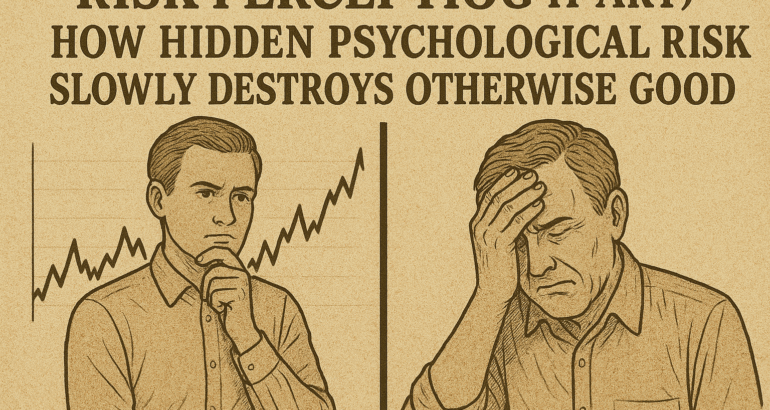
In Part 1, we dismantled the illusion that risk in trading is purely mathematical. We saw how traders respond not to real danger, but to felt risk, and how that mismatch quietly drives destructive behavior. Now we go deeper—into the risks traders almost never measure, yet suffer from the most.
These are the risks that do not show up on charts, position-size calculators, or backtests. They show up in fatigue, hesitation, compulsive behavior, emotional numbness, and eventual burnout.
This is where most trading careers actually end—not with a blown account, but with a broken relationship to decision-making.
The Risk of Cognitive Overload: When Too Much Information Becomes Dangerous
Modern traders consume enormous amounts of information. Multiple timeframes. Indicators. News feeds. Social media opinions. Macro narratives. Micro setups.
Each piece of information feels useful. Together, they create cognitive overload.
Cognitive overload does not feel like danger. It feels like being “busy,” “engaged,” or “thorough.” But under the surface, it dramatically increases risk by degrading decision quality.
When the brain is overloaded:
- Reaction times slow
- Pattern recognition weakens
- Emotional reactivity increases
- Rule adherence declines
This is why traders often make their worst decisions after long periods of analysis. The mind is exhausted before the trade even begins.
Professional traders intentionally limit inputs. Retail traders maximize them.
This is not an intelligence gap. It is a risk-management difference.
Why Complexity Feels Safe but Is Actually Dangerous
Complex systems feel robust. They give the illusion of control. Multiple confirmations feel like protection against error.
But complexity introduces fragility.
Each additional rule:
- Adds interpretation risk
- Increases hesitation
- Expands decision branches
- Raises the chance of inconsistency
Complex strategies fail not because they are wrong, but because humans cannot execute them reliably under pressure.
Professional traders simplify aggressively. Retail traders add complexity to feel safer.
This inversion explains why many traders become less consistent as they “learn more.”
The Risk of Emotional Accumulation
Emotions in trading do not reset automatically.
Small frustrations accumulate. Minor disappointments stack. Subtle self-doubt lingers. Over time, emotional load increases even if individual trades seem manageable.
This accumulation creates emotional debt.
Eventually, the trader reacts not to the current trade, but to everything that came before it.
This is why:
- A small loss triggers an outsized reaction
- A minor mistake leads to shutdown
- A single win causes reckless overconfidence
Professional traders manage emotional accumulation deliberately. They take breaks, reduce exposure, and stop trading when emotional load rises.
Retail traders push through, believing endurance equals professionalism.
It doesn’t. It increases risk.
The Hidden Risk of Trading Too Frequently
Frequency is one of the most misunderstood risk variables.
More trades do not necessarily mean more opportunity. They mean:
- More decisions
- More emotional swings
- More fatigue
- More chances to make mistakes
Each trade consumes mental capital. When mental capital runs low, execution deteriorates.
Professional traders trade as little as possible to express their edge. Retail traders trade as much as possible to feel productive.
Productivity is not performance.
Why Small Losses Can Be More Dangerous Than Large Ones
This sounds counterintuitive, but it is true.
Large losses are emotionally obvious. They force reflection. They trigger caution.
Small losses, especially repeated ones, create irritation without resolution. They drain patience. They erode confidence slowly. They provoke revenge trading more often than big losses.
A trader who takes ten small losses in a row is often in more psychological danger than one who takes a single large loss.
Professional traders monitor emotional response to loss size, not just account impact.
Retail traders assume small losses are harmless. They are not.
The Risk of Delayed Consequences
One of the most dangerous aspects of trading is delayed feedback.
Bad behavior is not always punished immediately. Good behavior is not always rewarded immediately.
This creates false learning.
A trader might:
- Break rules and make money
- Follow rules and lose money
Over time, this distorts risk perception. The trader begins to associate safety with bad habits and danger with discipline.
Professional traders judge behavior independently of outcome. Retail traders learn the wrong lessons from random feedback.
Delayed consequences are a silent killer.
The Risk of Psychological Ruin vs Financial Ruin
Most traders fear blowing their account. Few consider psychological ruin.
Psychological ruin occurs when:
- Trading becomes emotionally unsafe
- Decision-making is associated with anxiety
- Confidence cannot be restored
- Avoidance replaces engagement
Some traders still have capital but cannot pull the trigger. Others trade compulsively without clarity. Many quit not because they lost money, but because they lost trust in themselves.
Professional traders protect psychological capital more fiercely than financial capital.
Retail traders sacrifice it unknowingly.
Why Risk Feels Lower When You Are Wrong for the “Right Reasons”
Traders often justify risk-taking when it aligns with a narrative.
“This is a strong setup.”
“This makes sense fundamentally.”
“This should work.”
Narratives reduce perceived risk by creating meaning.
But markets do not reward narratives. They reward probability and execution.
The more convincing the story, the more risk traders are willing to take—even when exposure is excessive.
Professional traders are suspicious of stories. Retail traders are comforted by them.
The Risk of Trading to Regulate Emotion
Many traders unconsciously use trading to regulate emotional states.
They trade to:
- Escape boredom
- Relieve frustration
- Restore confidence
- Feel in control
- Prove competence
This is extremely dangerous.
When trading becomes emotional regulation, risk tolerance becomes distorted. The trader is no longer managing exposure—they are managing feelings.
Professional traders trade only when emotionally neutral. Retail traders trade to become emotionally neutral.
That inversion leads to chaos.
Why Risk Cannot Be Separated from Self-Awareness
Risk management is not just rules. It is self-observation.
Two traders with identical rules will experience different risk outcomes if:
- One is self-aware
- One is emotionally blind
Self-awareness allows early detection of:
- Impatience
- Overconfidence
- Fear
- Fatigue
Without self-awareness, risk escalates silently.
Professional traders constantly monitor themselves. Retail traders monitor only the market.
The Risk of Chasing “Optimal” Performance
Many traders aim for optimal returns, optimal efficiency, optimal strategies.
Optimization increases fragility.
Systems optimized for peak performance often collapse under stress.
Professional traders prioritize robustness over optimization. They accept lower peaks in exchange for survival across conditions.
Retail traders chase optimality and are shocked when systems fail outside ideal conditions.
Risk Is Contextual, Not Absolute
The same trade can be safe or dangerous depending on context:
- Time of day
- Emotional state
- Recent outcomes
- Market regime
- Fatigue level
Rules without context create blind spots.
Professional traders adjust exposure based on context. Retail traders apply rules mechanically and hope for consistency.
Context-awareness reduces risk more than any indicator.
Why Most Traders Underestimate Long-Term Risk
Short-term risk is visible. Long-term risk is abstract.
Traders see daily P&L but not cumulative stress. They feel today’s emotion but not slow burnout.
This leads to:
- Overtrading
- Under-recovery
- Ignoring warning signs
- Delayed collapse
Professional traders think in careers. Retail traders think in sessions.
Risk accumulates over time, not just per trade.
The Only Risk That Truly Matters
After stripping everything away, one risk dominates all others:
The risk that you will not be able to continue trading.
Not because of money—but because of psychological damage.
Everything else is secondary.
Professional traders optimize for continuity. Retail traders optimize for excitement or short-term performance.
Continuity wins.
Final Thought: Risk Is Not What You Lose — It Is What You Become
Trading does not just change your account balance. It changes your behavior, your confidence, your patience, and your relationship with uncertainty.
The greatest risk is not losing money.
It is becoming someone who cannot make clear decisions anymore.
At mavianalytics.com, we don’t teach traders to avoid losses.
We teach them to protect the part of themselves that makes good decisions possible.
Because capital can be rebuilt.
Clarity is much harder to recover.