

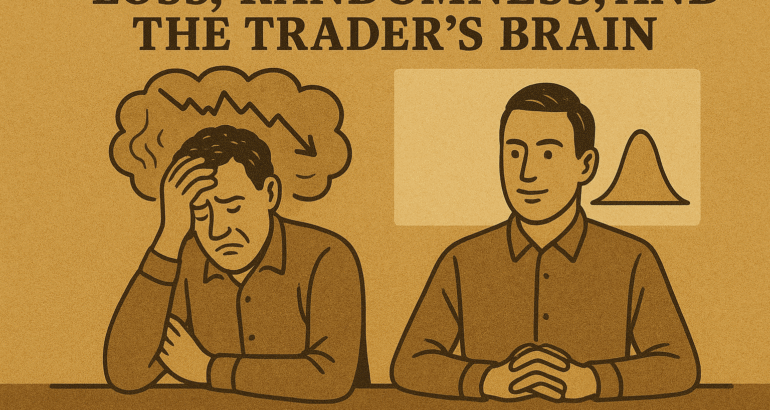
There is a moment every trader remembers clearly. A trade goes wrong. Not in a dramatic way. Not a sudden crash. Just a slow drift against you. You followed the setup. You respected the rules. You sized correctly. And still, you lost.
What hurts is not the money.
What hurts is the question that follows.
“What did I do wrong?”
This question feels responsible. It feels professional. It feels like growth. But very often, it is the wrong question—and it quietly damages a trader’s mind over time.
Because markets are probabilistic, but the human brain is not built to experience probability emotionally. It is built to look for cause, meaning, and blame. And when those instincts collide with randomness, trading becomes psychologically brutal.
This blog exists to explain why losses feel personal, why randomness feels unfair, and why most traders emotionally reject probability even after years in the market.
Why the Brain Hates Randomness More Than Losses
Losses alone are not what destabilize traders. Randomness is.
If you knew with certainty that every third trade would lose, losses would hurt less. You would expect them. You would budget for them mentally. But that is not how markets work.
Losses cluster.
Wins cluster.
Nothing arrives evenly spaced.
The brain experiences this as injustice.
Human cognition evolved in environments where outcomes had direct causes. If something bad happened, there was usually something to fix. Trading violates this expectation completely. You can do everything right and still lose. You can do everything wrong and still win.
The brain does not accept this easily.
So it starts searching for explanations that don’t exist.
The Emotional Error: Treating Losses as Feedback on Identity
One of the most damaging habits traders develop is interpreting losses as feedback about themselves.
A losing trade quietly becomes:
- “I misread the market”
- “I’m losing my edge”
- “I’m not good at this”
- “Something is wrong with me”
This is not rational.
But it is deeply human.
The brain is wired to protect identity. When something painful happens repeatedly, the mind tries to make sense of it by assigning meaning. In trading, that meaning often turns inward.
Professional traders learn to separate outcome from identity. Retail traders collapse the two.
This is why losing streaks damage confidence so deeply—even when execution quality hasn’t changed.
Why Random Losses Feel More Painful Than Predictable Ones
Predictable pain is easier to tolerate than random pain.
In trading, randomness creates emotional whiplash. A trader might experience:
- Three clean wins
- Followed by two clean losses
- Followed by one large loss
The brain experiences this not as statistics, but as chaos.
This chaos creates emotional tension. The trader starts tightening rules unnecessarily. Or loosening them. Or changing strategies. Or second-guessing everything.
Not because the strategy stopped working—but because the mind is desperate for stability.
The Probability Blind Spot Most Traders Never Fix
Most traders understand probability intellectually. Very few accept it emotionally.
Intellectual understanding sounds like:
“This strategy has a 55% win rate.”
Emotional acceptance sounds like:
“I am completely okay losing five times in a row while executing perfectly.”
Most traders never reach the second state.
Instead, they tolerate probability only when outcomes are favorable. When outcomes turn unfavorable, probability is forgotten, and self-judgment takes over.
This is where long-term damage begins.
Why Traders Try to “Fix” Randomness With Control
When faced with randomness, the brain instinctively seeks control.
This shows up as:
- Adding more indicators
- Seeking more confirmations
- Over-analyzing entries
- Adjusting stops constantly
- Switching timeframes
These behaviors feel productive. They feel like adaptation. But often, they are just anxiety in disguise.
The trader is not improving the system.
They are trying to emotionally escape uncertainty.
Professional traders do the opposite. When randomness increases, they simplify. They reduce exposure. They trust structure.
Retail traders increase effort. Professionals reduce decisions.
The Hidden Cost of “Why Did This Trade Lose?”
This question feels logical. But most of the time, it leads traders down the wrong path.
In a probabilistic environment, not every loss has a meaningful explanation. Forcing explanations where none exist creates false learning.
False learning is dangerous because it:
- Changes behavior unnecessarily
- Introduces rules that reduce expectancy
- Increases hesitation
- Weakens confidence
Professional traders ask a different question:
“Did I execute correctly?”
If yes, the loss is accepted without emotional processing.
If no, behavior is adjusted—not strategy.
This distinction protects mental capital.
Randomness Is Not the Enemy—Resistance to It Is
Most traders believe the market is the enemy. In reality, their resistance to randomness is the real problem.
Resistance looks like:
- Needing every trade to “make sense”
- Feeling betrayed by losing streaks
- Believing consistency should be smooth
- Expecting effort to reduce uncertainty
Markets do not reward acceptance.
But they punish resistance brutally.
Professional traders don’t like randomness.
They stop fighting it.
Why Losing Feels Unfair Even When It’s Normal
Fairness is a social concept. Markets are not social systems.
The brain expects fairness because most human systems are built around it. Trading violates this expectation. Outcomes are not distributed according to effort, intelligence, or discipline—at least not in the short term.
This creates emotional confusion:
“I did everything right. Why did I lose?”
The correct answer is:
“Because probability does not reward correctness on a trade-by-trade basis.”
Until this truth is fully accepted, traders will keep seeking emotional justice in an unjust system.
The Difference Between Damage and Drawdown
This is a critical distinction.
A drawdown is statistical.
Damage is psychological.
Drawdowns are inevitable. Damage is optional.
Damage occurs when:
- Losses alter behavior
- Confidence collapses
- Rules are abandoned
- Identity is questioned
Professional traders experience drawdowns without damage because losses are already mentally accounted for.
Retail traders experience damage because losses feel like surprises.
How Professionals Mentally Price Losses Before They Occur
This is one of the most powerful yet least discussed skills.
Professionals do not just define risk in money terms. They define it emotionally.
Before a trade, they already accept:
- The loss
- The sequence possibility
- The emotional discomfort
By the time the loss occurs, it is not processed emotionally. It is processed administratively.
This is why professionals recover faster.
They are not healing from shock.
Why Many Traders Quit Right After “Figuring It Out”
A strange pattern appears repeatedly. Traders often quit shortly after they improve.
Why?
Because improved execution increases exposure to pure randomness. When behavior improves, mistakes decrease, but losses still occur. This feels deeply unfair.
The trader thinks:
“I’m finally doing things right, and I’m still losing.”
Without a correct understanding of randomness, this phase feels like betrayal instead of progress.
Many traders quit at the exact moment they were closest to consistency.
Accepting Randomness Is Not Passive—It Is Mature
Acceptance does not mean resignation.
It means:
- Not overreacting to outcomes
- Not changing behavior unnecessarily
- Not personalizing variance
- Not demanding emotional comfort from markets
This level of acceptance takes time. But once developed, it stabilizes everything.
FAQ
Why do losses hurt more after I improve my trading?
Because expectations increase before emotional acceptance catches up.
Is it normal to have losing streaks even with a good strategy?
Yes. Streaks are a feature of probability, not a flaw.
Should I analyze every losing trade?
Only if execution was flawed. Otherwise, analysis creates noise.
How do professionals stay emotionally stable during drawdowns?
They pre-accept randomness and reduce exposure when clarity drops.
Does accepting randomness mean lowering standards?
No. It means separating behavior from outcomes.
Final Thought: Trading Breaks Those Who Demand Fairness
Markets are not fair.
They are not personal.
They are not moral.
They are probabilistic systems that reward consistency over time—not correctness in the moment.
If you keep demanding emotional justice from randomness, trading will exhaust you. But if you learn to accept uncertainty without resistance, something shifts internally.
Losses stop feeling personal.
Confidence stabilizes.
Behavior improves.
At mavianalytics.com, we don’t teach traders to avoid losses.
We teach them to stop being psychologically damaged by them.
Because survival in trading is not about avoiding randomness.
It is about learning to live inside it.