

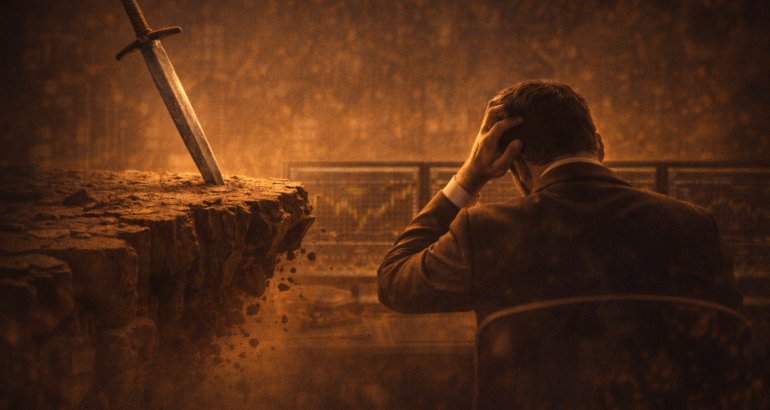
The Slow Erosion That Happens Long Before Results Collapse
Most traders believe losing their edge is a sudden event. They imagine one bad year, one big mistake, or one market shift that breaks everything. When they think of failure, they picture explosions, not erosion.
In reality, traders rarely lose their edge overnight. They lose it slowly, quietly, and almost invisibly. Performance does not collapse at first. It dulls. Decisions feel heavier. Reactions become slower. Conviction weakens. What once felt natural starts requiring effort.
By the time traders notice something is wrong, the edge has often been fading for months or even years.
This chapter explains how that erosion happens, why traders don’t recognize it early, and what separates those who quietly recover from those who slowly disappear.
An edge is not just a strategy. It is a state of alignment between skill, perception, risk control, and emotional stability. When all four are working together, trading feels demanding but manageable. Decisions flow. Mistakes happen, but recovery is quick.
When traders lose their edge, it is usually because one of these elements drifts out of alignment while the others remain unchanged. The system still looks the same on paper, but execution begins to degrade.
This makes the problem difficult to detect, because nothing appears obviously broken.
One of the earliest signs of edge erosion is subtle hesitation.
Trades that once felt clear now invite second-guessing. Entries are delayed. Exits feel uncertain. The trader spends more time thinking and less time acting. This hesitation does not come from lack of knowledge. It comes from reduced trust.
The trader still understands the system, but no longer feels anchored to it.
At this stage, results may still be acceptable. That is why the warning goes unnoticed.
Another early sign is emotional flattening.
Trading stops feeling engaging. Wins don’t excite. Losses don’t teach. Everything feels muted. Traders often misinterpret this as maturity, believing they have become calmer or more professional.
Sometimes that is true. Often it is not.
Emotional flattening can be a sign of mental fatigue or quiet burnout. The trader is still operating, but without curiosity or presence. Decisions are made mechanically, not attentively.
This dullness slowly erodes edge because trading requires awareness, not autopilot.
Many traders lose their edge by becoming over-reliant on experience.
Experience is valuable, but it can quietly turn into assumption. Traders stop questioning patterns. They assume they already know how situations will play out. They become less open to new information.
Markets change slowly, not abruptly. When traders rely too heavily on past familiarity, they miss small shifts in behavior, volatility, or structure. They are not wrong often, but they are wrong more often than before.
Edge weakens through small misreads, not obvious errors.
Another common cause of edge erosion is comfort with mediocrity.
After years of effort, some traders reach a level that feels “good enough.” They are not exceptional, but they are no longer struggling. This stability feels like relief.
Over time, however, comfort reduces urgency. Review becomes less rigorous. Discipline becomes assumed rather than enforced. The trader still believes they are sharp, but the sharpness dulls quietly.
Edge requires ongoing engagement. Comfort without curiosity slowly erodes it.
Success itself can accelerate edge loss.
Winning periods increase confidence, but they also reduce vigilance. Traders loosen routines. They skip reviews. They rely more on instinct and less on structure. Small deviations creep in unnoticed.
Nothing goes wrong immediately, which reinforces the behavior. By the time losses appear, the trader no longer remembers exactly when discipline loosened.
The edge did not fail.
It was slowly abandoned.
Another subtle contributor is identity attachment.
When traders define themselves as “experienced,” “professional,” or “consistent,” they resist acknowledging decline. They explain poor performance through external reasons rather than internal drift.
This is not arrogance. It is self-protection.
Admitting edge erosion feels like admitting regression. Many traders avoid that discomfort by rationalizing results instead of examining behavior.
Edge continues fading in the background.
Mental fatigue is one of the most underestimated causes of edge loss.
Trading demands sustained attention under uncertainty. Over years, this takes a toll. Traders who do not actively manage recovery slowly operate from depleted mental states.
They still trade. They still analyze. But their reactions are slower. Their emotional recovery takes longer. Their tolerance for stress drops.
This fatigue does not announce itself loudly. It whispers through small lapses in judgment.
Many traders lose their edge by doing too much.
As skill improves, opportunities appear everywhere. The trader sees setups in more instruments, timeframes, and markets. Activity increases. Cognitive load rises.
At first, this feels like growth. Over time, it fragments attention.
Edge thrives on focus. When attention is scattered, execution quality declines even if opportunity increases. The trader is busy but less precise.
This dilution of focus quietly weakens edge.
A dangerous phase occurs when traders begin trading their expectations instead of their system.
They expect certain outcomes because they have “seen this before.” When reality deviates, frustration appears. Trades are managed emotionally rather than structurally.
The trader is no longer responding to what is happening, but to what should be happening.
Markets punish expectation rigidity. Edge erodes when flexibility disappears.
Another sign of edge loss is delayed recovery.
Losses take longer to process. Emotional balance returns more slowly. The trader feels unsettled for days instead of hours.
This is not because losses are larger. It is because internal resilience has weakened.
Recovery speed is a key indicator of edge health. When recovery slows, something deeper is shifting.
Some traders lose their edge because they stop learning, even though they keep studying.
They consume information passively without integration. New ideas are collected but not tested deeply. Learning becomes intellectual rather than experiential.
Edge comes from applied understanding, not accumulated knowledge. When learning becomes superficial, growth stalls and erosion begins.
Markets themselves contribute to edge erosion through extended periods of randomness.
During choppy or directionless phases, even good traders struggle. Over time, repeated frustration alters behavior. Traders begin forcing trades, adjusting rules, or doubting systems.
If this phase lasts long enough, the trader adapts to noise instead of structure.
When markets eventually normalize, the trader’s behavior no longer fits them.
One of the most dangerous moments is when traders say, “I just need a break.”
Breaks are necessary, but they do not automatically restore edge. Without reflection, traders often return with the same habits and reduced sharpness.
Recovery requires intentional recalibration, not just time away.
Professional traders detect edge erosion early by monitoring behavioral signals, not P&L.
They notice changes in patience, clarity, and emotional recovery. They adjust size, frequency, and expectations before damage compounds.
Retail traders often wait for financial proof. By then, recovery is harder.
Regaining edge is rarely about adding something new. It is usually about removing drift.
Professionals simplify. They reduce markets, setups, and screen time. They revisit fundamentals. They restore routines that once anchored them.
This feels like regression, but it is restoration.
Edge returns when the trader reconnects with process over outcome.
When decisions are evaluated based on quality rather than result, confidence stabilizes. Emotional reactivity decreases. Trust rebuilds slowly.
The trader does not suddenly feel sharp again. They become steady again.
Some traders never fully lose their edge, but they never regain it either. They operate permanently below potential.
Others recognize erosion early, accept it without ego, and rebuild patiently.
The difference is not intelligence or talent.
It is honest self-observation.
Edge is not a possession.
It is a condition.
It must be maintained, protected, and occasionally rebuilt.
Those who treat it as permanent eventually lose it.
Those who treat it as fragile keep it longer than others.
The most dangerous thought in trading is, “I’m fine.”
Most declines begin right after that sentence.
Losing your edge does not mean you are failing.
It means something important needs attention.
Traders who respond early survive.
Those who ignore the signs fade quietly.
Trading mastery is not about constant improvement.
It is about preventing slow decline.
Those who understand this stay in the game long enough for skill to matter.
Those who don’t often leave wondering what changed.