

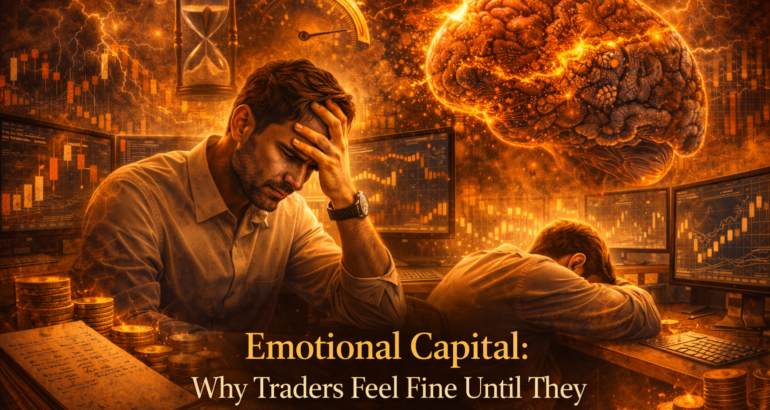
Most traders can point to the moment they “lost it.”
The day they over-traded.
The week they broke every rule.
The phase where discipline collapsed almost overnight.
What makes this experience confusing is that it rarely feels predictable. In hindsight, traders say things like “I don’t know what happened” or “I was doing fine until suddenly I wasn’t.” They search for a trigger — a big loss, bad news, a personal problem — but often nothing obvious explains the breakdown.
This confusion exists because traders are taught to track only financial capital, while the real depletion happens elsewhere.
Emotional capital is not a motivational concept. It is not confidence, positivity, or mindset. It is the brain’s capacity to tolerate uncertainty, delay resolution, and absorb loss without distorting decisions. Like financial capital, it is finite. Unlike financial capital, it is rarely measured, rarely protected, and almost always overused.
This is why traders don’t feel themselves breaking down gradually. Emotional capital does not drain loudly. It drains quietly, while performance appears stable.
In the early stages of a trading career, emotional capital feels abundant. Losses hurt, but they recover quickly. Stress appears during trades, but fades afterward. The trader can reset overnight. Drawdowns feel uncomfortable but manageable. There is still separation between trading outcomes and personal identity.
Over time, this separation narrows.
Each open trade requires the brain to hold uncertainty. Each loss requires the brain to process disappointment. Each missed opportunity requires suppression of regret. Each win requires restraint to avoid overconfidence. None of these processes are free. They consume emotional resources in small amounts that feel insignificant in isolation.
This is where most traders misjudge their condition. Because no single trade feels overwhelming, they assume they are fine. Emotional capital does not announce depletion the way money does. There is no balance sheet. There is no margin call. There is only subtle change in internal response.
One of the first signs is delayed recovery. After a losing trade, the emotional residue lingers longer than it used to. The trader may still follow rules, but the effort required feels higher. They replay trades mentally. They feel tension during off-market hours. Sleep quality changes. These are not psychological weaknesses. They are indicators of load accumulation.
Another early sign is reduced tolerance for ambiguity. Trades that previously felt acceptable now feel uncomfortable. Waiting becomes harder. Flat periods feel irritating. The trader begins to seek resolution faster — not because the strategy changed, but because the internal buffer shrank.
At this stage, many traders unknowingly increase pressure. They trade more to “get back in rhythm.” They monitor more closely to feel engaged. They tighten rules inconsistently. All of these behaviors consume more emotional capital, not less.
The depletion accelerates quietly.
What makes emotional capital particularly dangerous is that it often declines while performance remains intact. A trader can still be profitable while running on reserves. This creates a false sense of safety. The trader believes that as long as results are acceptable, the system is healthy.
It isn’t.
Emotional capital works like fatigue in the nervous system. You don’t feel its absence until it’s nearly gone. When it reaches a critical threshold, behavior changes abruptly. This is why breakdowns feel sudden. The system did not fail overnight. It crossed a line.
When emotional capital is low, the brain’s priorities shift. Instead of optimizing for long-term expectancy, it begins optimizing for immediate relief. This shift explains a wide range of destructive behaviors.
Over-trading appears because activity reduces helplessness.
Early exits appear because closure feels safer than uncertainty.
Rule-bending appears because rigidity feels intolerable.
Revenge trading appears because identity repair becomes urgent.
None of these behaviors feel irrational in the moment. They feel necessary.
This is why telling traders to “stay disciplined” during these phases rarely works. Discipline itself requires emotional capital. Asking a depleted system to exert more control is like asking an exhausted muscle to lift heavier weight.
Another reason emotional capital is misunderstood is because it is often confused with confidence. Traders assume that if they feel confident, they are fine, and if they feel doubtful, they are struggling. In reality, confidence can increase even as emotional capital decreases.
Confidence often rises after winning streaks. Size increases. Exposure increases. Responsibility increases. Emotional load increases with it. The trader feels strong, but the system is becoming fragile. When losses arrive — as they inevitably do — the emotional drawdown is far deeper than expected.
This is why some of the worst breakdowns happen after success, not failure.
There is also a cumulative effect unique to trading. Unlike many professions, traders rarely get clean emotional resolution. Losses are frequent and expected, but never fully “finished.” A losing trade ends financially, but emotionally it often remains open. The trader questions execution, timing, and judgment. The brain stores these unresolved evaluations.
Over months and years, these unresolved fragments accumulate. The trader carries them forward unknowingly. Emotional capital is spent not only on current trades, but on the residue of past ones.
This accumulation explains why experienced traders can suddenly behave worse than beginners. Experience brings memory. Memory brings comparison. Comparison brings pressure.
Another overlooked drain is constant self-monitoring. Traders are encouraged to journal, review, and reflect — all valuable practices. But when done excessively or emotionally, they become another source of load. The trader is not just trading; they are continuously judging themselves. This internal observation consumes emotional bandwidth.
When emotional capital is healthy, self-review feels informative. When it is depleted, self-review feels accusatory. The content may be the same, but the internal effect is different.
The most dangerous phase is not when traders feel stressed. It is when they feel numb. Numbness often appears after prolonged depletion. The trader stops reacting strongly to wins or losses. Motivation drops. Engagement becomes mechanical. At this point, discipline may appear externally intact, but internally the system is disengaging.
This is often misdiagnosed as laziness or loss of passion. In reality, it is a protective shutdown.
Recovery of emotional capital does not come from time alone. Many traders take breaks and return unchanged. Recovery requires reducing ongoing drain, not just resting. If the same structural pressures remain, emotional capital will deplete again.
This is where system design becomes critical. Traders who last long-term unconsciously or deliberately design their trading to protect emotional capital. They trade less frequently. They accept missed opportunities. They define exits clearly. They avoid constant monitoring. They keep size boring. They reduce identity attachment.
These behaviors look conservative from the outside. Internally, they are survival mechanisms.
Importantly, protecting emotional capital often feels like under-trading. It feels like leaving money on the table. This discomfort is real. But it is different from depletion discomfort. One is tolerable. The other is corrosive.
Traders who ignore emotional capital usually don’t fail because of bad strategies. They fail because their decision-making environment becomes hostile to their own nervous system. The brain stops cooperating. Execution deteriorates. Self-trust collapses.
By the time this happens, the trader often believes something is “wrong” with them. They try to fix psychology directly. They seek motivation, confidence, or discipline. But the issue is not character. It is capacity.
Emotional capital is not restored by pushing harder. It is restored by asking less of the system.
The market will always demand uncertainty. The trader decides how much of that uncertainty they carry at once.
When emotional capital is treated as a real asset — finite, drainable, and essential — behavior begins to make sense. Breakdowns stop looking mysterious. They look mechanical. And mechanical problems can be redesigned.