

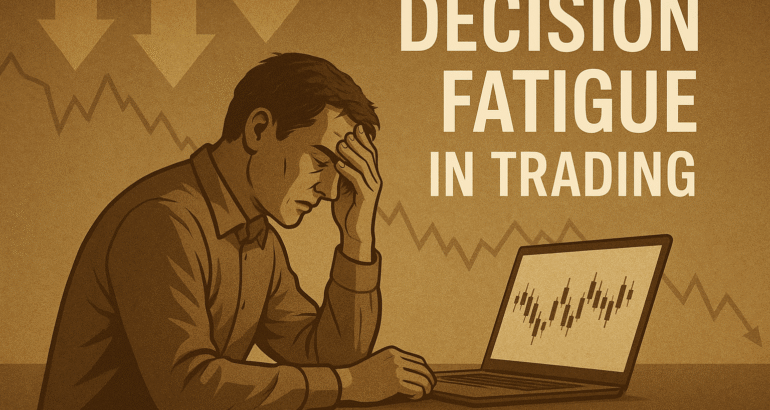
Decision Fatigue in Trading: Why the Brain Starts Making Bad Trades Before You Even Realize It
There comes a strange phase in a trader’s day when nothing feels obviously wrong, yet everything starts slipping. You are not emotional in the dramatic sense. You are not angry, euphoric, or panicked. You are simply… tired. Not physically, but mentally. And it is in this quiet, almost invisible state that some of the worst trading decisions are made.
You start taking trades that you would normally avoid. You loosen rules slightly. You justify entries that don’t fully align. You tell yourself it’s fine because “it’s just one trade.” At the end of the day, when you look back, the losses don’t feel shocking. They feel confusing. You can’t point to a single big mistake. Everything just degraded.
This is not lack of discipline.
This is decision fatigue.
And almost no trader understands how dangerous it really is.
Why Traders Think They Are Making Rational Decisions (When They’re Not)
Most traders assume that bad decisions come from emotions like fear or greed. That belief is comforting because emotions are obvious. You can feel them. You can blame them. You can try to control them.
Decision fatigue is different. It is quiet. It doesn’t announce itself. You still feel logical. You still feel reasonable. In fact, that’s what makes it dangerous.
Decision fatigue occurs when your brain has already spent a large amount of cognitive energy making decisions earlier—analyzing charts, watching price, filtering noise, managing risk, dealing with small wins and losses. Over time, the brain starts conserving energy. And when it does, it doesn’t shut down. It simplifies.
Simplification sounds efficient, but in trading, it often means:
- Lower standards
- Faster justifications
- Reduced patience
- Increased impulsivity disguised as logic
By the time you notice something is off, damage is already done.
The Brain Was Never Designed for Continuous Probabilistic Decisions
This is where most trading education completely fails. Humans did not evolve to make hundreds of probabilistic decisions with delayed feedback, abstract risk, and no physical cues of danger.
In normal life:
- Decisions have visible consequences
- Feedback is relatively quick
- Risk is tangible
In trading:
- Consequences are delayed
- Feedback is noisy
- Risk is abstract numbers on a screen
Your brain works harder than you realize just to stay engaged. Every chart you watch, every setup you evaluate, every trade you consider consumes mental energy. Decision fatigue is not weakness. It is biology.
Professional traders do not overcome this with willpower.
They design around it.
Why Overtrading Is Often a Fatigue Problem, Not Greed
Most traders believe overtrading comes from greed or impatience. Sometimes it does. But very often, overtrading is a symptom of decision fatigue.
As mental energy drops, the brain looks for relief. Taking a trade feels like doing something. It feels like progress. It reduces the discomfort of waiting. This is why traders start forcing trades late in the session or after a series of small decisions.
The trade is not the goal.
Relief is.
This is why telling traders to “just be disciplined” rarely works. You are asking a tired brain to behave optimally without reducing its workload.
The Silent Degradation of Trade Quality
One of the most dangerous aspects of decision fatigue is that it doesn’t cause dramatic errors immediately. Instead, it causes micro-compromises.
A slightly worse entry.
A slightly wider stop.
A slightly earlier exit.
A trade taken without full alignment.
Individually, these seem harmless. Collectively, they destroy expectancy.
Traders often review their day and feel confused because there was no obvious mistake. But performance didn’t collapse suddenly. It eroded.
Decision fatigue kills trading accounts slowly, not explosively.
Why Watching Markets All Day Makes You Trade Worse
Many traders believe that more screen time equals more opportunity. In reality, excessive observation without clear structure increases cognitive load.
Every tick watched is a decision not to act.
Every candle analyzed is a judgment made.
Every “maybe” trade considered is mental effort spent.
By the time a high-quality setup appears, the brain is already tired. Execution suffers. Hesitation increases. Confidence drops.
Professional traders limit exposure deliberately. They are not less engaged. They are more selective with attention.
Attention is a resource.
Once depleted, decision quality follows.
The False Discipline Trap
Here is a subtle trap traders fall into: they believe discipline means continuing to make good decisions no matter what. This belief creates self-blame when fatigue sets in.
In reality, discipline is not about enduring fatigue.
Discipline is about preventing fatigue from influencing decisions.
Professionals don’t push through exhaustion. They step away before it compromises behavior. Retail traders push harder, believing effort equals professionalism.
Effort is not the solution.
Design is.
Why Motivation Fails Against Decision Fatigue
Motivation is emotional energy. Decision fatigue is cognitive depletion. These are different systems.
You can feel motivated and still be mentally exhausted. This is why pep talks, affirmations, and “stay strong” advice fail in trading. They target the wrong layer.
No amount of motivation can restore depleted decision-making capacity. Only reduced load, structure, and rest can.
This is why professional trading environments are built around:
- Limited decision windows
- Clear rules
- Reduced choices
- Pre-commitments
They don’t rely on mental toughness.
They remove unnecessary decisions.
The Professional Solution: Decision Reduction, Not Better Decisions
This is a critical shift. Professionals are not better decision-makers because they think harder. They are better because they make fewer decisions.
They decide:
- When to trade
- When not to trade
- How many trades per day
- When the day is over
These decisions are made once, not repeatedly.
Retail traders decide everything in real time. Professionals decide most things in advance.
This single difference explains a huge performance gap.
How Decision Fatigue Shows Up in Your Trading (Without You Noticing)
You may be experiencing decision fatigue if:
- You feel mentally “foggy” but still trade
- You start justifying trades more than usual
- You feel relief after entering trades, even bad ones
- You trade more late in the session
- You review trades and can’t explain why you took some of them
These are not moral failures.
They are signals.
Ignoring them is costly.
Why “Take a Break” Is Good Advice (But Incomplete)
Many people say, “Just take a break.” While breaks help, they are reactive. The real solution is structural prevention.
Professionals design trading days so that breaks are built in naturally:
- Fixed trading windows
- Trade limits
- Mandatory stop points
- Clear session boundaries
They don’t wait to feel tired.
They assume fatigue will come and plan accordingly.
Reframing What It Means to Be a Serious Trader
Serious trading is not about:
- How long you can watch screens
- How many trades you can take
- How much information you can process
It is about:
- How well you protect decision quality
- How early you stop when clarity drops
- How little you rely on willpower
This reframing alone changes behavior dramatically.
FAQ
Why do I trade worse later in the day?
Because cognitive resources deplete over time, even if emotions feel stable.
Is decision fatigue the same as emotional trading?
No. Decision fatigue often leads to emotional mistakes, but it begins cognitively.
Can experience eliminate decision fatigue?
Experience helps recognize it earlier, but no one is immune.
Should I trade fewer hours?
Most traders improve when they trade fewer, more focused windows.
Why do professional traders look relaxed?
Because their systems protect them from constant decision-making.
Final Thought: Protecting Your Mind Is Protecting Your Capital
Most traders try to protect money with stops and sizing. Very few protect the mind that makes the decisions.
Decision fatigue is not dramatic. It doesn’t announce itself. It quietly lowers standards until losses feel “normal.”
If you want consistency, stop trying to be mentally strong all the time. Start designing your trading so that strength is not required.
At mavianalytics.com, we believe real edge comes from understanding how the human mind actually works under pressure—not how we wish it worked.
This blog is not a warning.
It is an explanation.
And once you understand it, you’ll never look at overtrading—or yourself—the same way again.